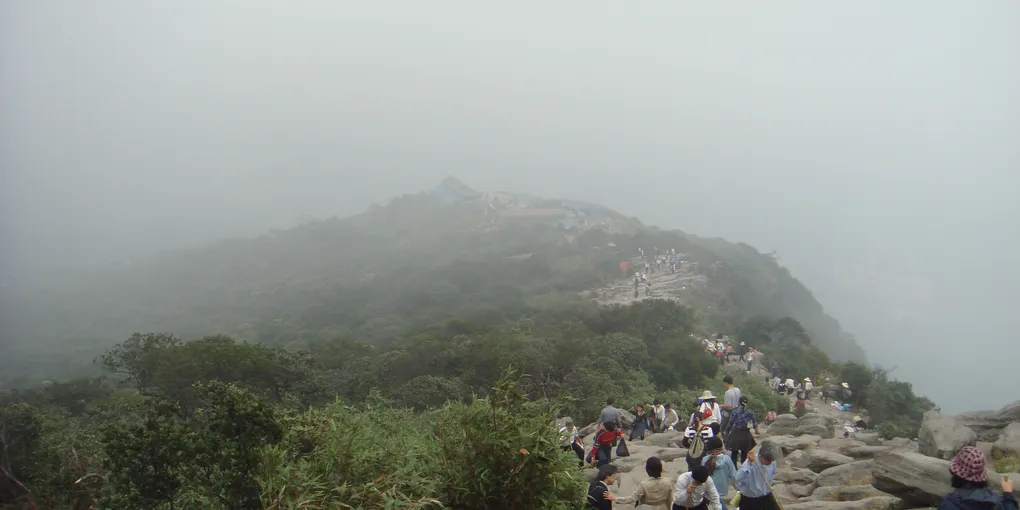
Most rulers in history had to be dragged off the throne. Trần Nhân Tông walked away from it. He led Đại Việt through the two hardest wars of the thirteenth century, gave power to his son while still in his thirties, and spent his last years as a monk on a misty mountain in what is now Quảng Ninh. Vietnamese call him Phật hoàng, the Buddha-King. The school of Zen he founded there, Trúc Lâm (“Bamboo Grove”), is still the only Zen tradition that began in Vietnam.
A king for wartime
He was born Trần Khâm on 7 December 1258, the eldest son of King Trần Thánh Tông. That same year Đại Việt had just thrown back the first Mongol raid. In 1278 his father passed him the throne, and the young king spent the next decade preparing for the Mongols to come back. They did, twice.
At the end of 1284, with Kublai Khan’s second invasion about to cross the border, the court called elders from across the country to the Diên Hồng palace and asked them whether to fight or make terms. The Đại Việt sử ký toàn thư records that they answered “Fight!” with one voice. The assembly was convened by the retired king Thánh Tông, with Nhân Tông reigning beside him. Seven centuries later, “the Diên Hồng spirit” is still the stock Vietnamese phrase for national consensus in a crisis.
The wars themselves belong to the generals, above all Trần Hưng Đạo, whose victory on the Bạch Đằng River in April 1288 ended the third invasion (I wrote about the stakes here). Nhân Tông’s part was holding the court together through two evacuations of the capital. A few days after Bạch Đằng, the king went to the tomb of his grandfather Trần Thái Tông in Long Hưng to present the victory. Tradition says he found the stone horses guarding the tomb caked in mud, as if they too had been to war, and wrote two lines:
Xã tắc lưỡng hồi lao thạch mã, Sơn hà thiên cổ điện kim âu.
Roughly: “Twice the nation has worn out its stone horses; these mountains and rivers will stand for ever, firm as a golden bowl.” The mud is legend. That the lines are his, written at his grandfather’s tomb in 1288, is the standard attribution.
Stepping down, on purpose
In 1293 Nhân Tông handed the throne to his son, Trần Anh Tông, and became Thái thượng hoàng, the retired king. This was not eccentricity. The Trần dynasty made a system of it: kings abdicated early and kept guiding the young ruler from behind, so the succession was settled while the father was still alive to enforce it. Nhân Tông’s father and grandfather had done exactly the same.
What was unusual was what he did next. In 1299 he went up Yên Tử, a mountain long holy to Buddhists, and became a monk under the name Hương Vân Đại Đầu Đà, committing himself to the strict ascetic practices. There he founded Trúc Lâm. Indian and Chinese Buddhism had come to Vietnam over many centuries; Trúc Lâm is usually described as drawing the existing Zen lineages together into a single Vietnamese school, with a Vietnamese founder, Vietnamese texts and Vietnamese patriarchs. After Nhân Tông came Pháp Loa and then Huyền Quang, remembered as the three founding patriarchs.
His best-known work, Cư trần lạc đạo phú (“Living in the World, Joyful in the Way”), was written in chữ Nôm, the Vietnamese demotic script, rather than in classical Chinese. That choice matters: it put serious Buddhist thought into the language people actually spoke. The work ends with a four-line verse many Vietnamese still know by heart:
Cư trần lạc đạo thả tùy duyên, Cơ tắc xan hề khốn tắc miên. Gia trung hữu bảo hưu tầm mịch, Đối cảnh vô tâm mạc vấn thiền.
“Live in the world, enjoy the Way, and go with what comes. Eat when hungry, sleep when tired. The treasure is already in your house, so stop searching. Meet the world without grasping, and you need not ask about Zen.” It is a strikingly unmonastic message from a man who had just left the palace for a mountain: enlightenment is not somewhere else.
Diplomacy from a monk’s robe
Retirement did not mean leaving politics. In 1301 Nhân Tông travelled south to Champa and stayed about nine months at the court of King Chế Mân (Jaya Simhavarman III). During the visit he promised Chế Mân his daughter, Princess Huyền Trân. The marriage took place in 1306, and in return Champa ceded two districts, Ô and Lý, which Đại Việt renamed Thuận and Hóa. That is the origin of the name Thuận Hóa, the region around today’s Huế. Chế Mân died about a year later; Huyền Trân, expected under Cham custom to follow him in death, was brought home by the mandarin Trần Khắc Chung. The romance between the two that later stories add has no historical basis.
The end on Yên Tử
In his last years Nhân Tông travelled the country teaching monks and urging ordinary people to keep the Ten Good Deeds of Buddhist ethics. He named Pháp Loa as his successor and died on 16 December 1308 at the Ngọa Vân hermitage on Yên Tử, aged 50 (51 by Vietnamese reckoning).
Why it still matters
Every spring, crowds of pilgrims climb Yên Tử to the small bronze pagoda on the summit, the route in the photo above. In July 2025 UNESCO inscribed the Yên Tử – Vĩnh Nghiêm – Côn Sơn, Kiếp Bạc complex as Vietnam’s ninth World Heritage site, with Trúc Lâm Buddhism at its core. The deeper legacy is the combination he stood for. Most nations keep their war heroes and their sages in separate rooms. Vietnam keeps one man who was both, and who decided, at the height of his power, that he had done enough.
Sources
- Trần Nhân Tông — Wikipedia
- Trần Nhân Tông — Wikipedia tiếng Việt
- Trúc Lâm — Wikipedia
- Huyền Trân — Wikipedia
- Trần Nhân Tông, the King and the Buddha of the Vietnamese — Việt Nam News
- Vua Trần Nhân Tông — Anh hùng dân tộc kiêm triết gia, thi sĩ — Nhân Dân
- Tinh thần Diên Hồng sống mãi — Tuổi Trẻ
- Đọc bài kệ Cư trần lạc đạo — Tạp chí Nghiên cứu Phật học
- Yên Tử – Vĩnh Nghiêm – Côn Sơn – Kiếp Bạc complex recognised as world cultural heritage — Việt Nam News
Cover photo: pilgrims on the ridge of Mount Yên Tử, with Chùa Đồng on the summit in the mist, by Thang Nguyen, CC BY-SA 2.0, via Wikimedia Commons.
