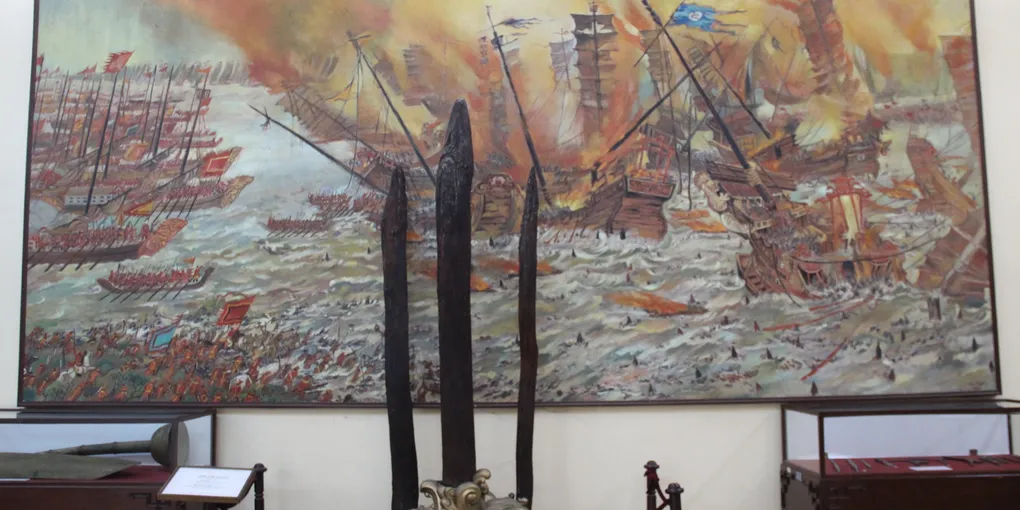
Most battlefields are remembered for a general or a date. The Bạch Đằng is remembered for a piece of wood. Twice in Vietnamese history, three and a half centuries apart, invading fleets sailed into this tidal estuary near Hạ Long Bay and were destroyed by the same trick: rows of sharpened stakes driven into the riverbed, hidden at high tide and deadly at low tide. Some of those stakes are still there, in fields and ponds that used to be river.
A river that breathes twice a day
The Bạch Đằng runs to the sea between today’s Quảng Ninh and Hải Phòng, through a maze of channels, mangroves and mudflats. It is a strongly tidal river. At high water a deep-hulled warship can sail well inland. A few hours later the same channel can be shallow enough to strand it.
Anyone defending the delta of the Red River had to think about this estuary. It was the natural sea road from the south coast of China towards the Vietnamese heartland. Whoever understood its tides could turn the river itself into a weapon.
938: Ngô Quyền and the end of a millennium
In the early tenth century the land that would become Việt Nam was a self-governing circuit called Tĩnh Hải quân, nominally part of the Chinese world. In 937 its governor, Dương Đình Nghệ, was assassinated by one of his officers, Kiều Công Tiễn. Dương’s son-in-law, Ngô Quyền, marched to avenge him. Kiều Công Tiễn asked the Southern Han kingdom, based in Guangzhou, for help. Its ruler, Liu Yan, sent a fleet under his son Liu Hongcao (Lưu Hoằng Tháo in Vietnamese).
By the time the fleet arrived, Ngô Quyền had already killed Kiều Công Tiễn. He had also prepared the Bạch Đằng. According to the chronicles, he had large stakes with iron-capped points planted in the riverbed. At high tide in late 938, small Vietnamese boats rowed out, provoked the Han ships and fell back upstream, drawing them over the hidden stakes. When the tide turned, Ngô Quyền’s forces attacked. The heavy ships, trying to retreat towards the sea, were caught on the stakes as the water dropped. Liu Hongcao was killed along with, by the usual account, more than half his army. Liu Yan abandoned the campaign.
In spring 939 Ngô Quyền declared himself king and set his capital at Cổ Loa, the ancient citadel north of today’s Hà Nội. Vietnamese historians treat 938 as the end of roughly a thousand years of Chinese rule. Later dynasties were often pushed to send tribute, but the country was never again simply a Chinese province, except during the Ming occupation of 1407–1427.
981: an echo
The river saw war again in 981, when a Song dynasty army invaded and Lê Hoàn, newly crowned, defeated it. Vietnamese accounts say he too staked a river mouth, and fighting reached the Bạch Đằng. The details of that campaign are thinner, though, and historians still disagree about exactly where the Song commander Hầu Nhân Bảo fell. The battles that made the river famous are the first and the last.
1288: Trần Hưng Đạo and the Mongol fleet
Three centuries later the threat was the largest empire the world had seen. Kublai Khan’s Yuan dynasty had already invaded Đại Việt in 1258 and 1285. In late 1287 it came a third time, with a land army under Prince Toghon and a large fleet.
The Trần court’s strategy was to empty the country in front of the invader and starve him. Early on, the general Trần Khánh Dư destroyed the Yuan supply convoy near Vân Đồn. Without supplies, the Yuan position around Thăng Long became untenable by spring 1288. Toghon ordered a withdrawal. The fleet, under the commanders Omar (Ô Mã Nhi) and Fan Yi (Phàn Tiếp), would return to the sea by way of the Bạch Đằng.
The supreme commander, Trần Hưng Đạo, knew the history of the river and repeated it on a larger scale. Fields of stakes were planted in the channels the fleet had to use. On 9 April 1288 the Yuan ships entered the estuary at high water and were attacked. As the tide ebbed they were caught on the stakes and destroyed with fire and boarding attacks. The chronicles say about four hundred ships were captured. Omar was taken prisoner, and Fan Yi did not survive. Toghon escaped overland, and Kublai, furious, banished him to Yangzhou. There was no fourth invasion. Đại Việt sent tribute to keep the peace, but it kept its independence.
The stakes in the mud
None of this would be more than chronicle if the stakes had rotted away. They did not. River silt cut off the oxygen and preserved the wood for seven centuries.
In 1953 people digging earth for a dyke in Yên Giang, in today’s Quảng Yên (Quảng Ninh), struck buried wooden stakes, and excavations followed in 1958. Two more stake fields were found nearby: Đồng Vạn Muối in 2005 and Đồng Má Ngựa in 2009. Radiocarbon dates from the stakes cluster in the thirteenth century, which matches the battle of 1288. The site was ranked a special national relic in 2012. Today Yên Giang is the one field where visitors can see the stakes in an open pond, about 120 square metres. The other two were reburied to protect the wood.
Then in October 2019 farmers in the Cao Quỳ field across the river in Hải Phòng hit two large timbers about a metre down. Archaeologists opened nearly 1,000 square metres and found 27 stakes, mostly of the hardwoods sến and lim, 10 to 40 centimetres thick. They were radiocarbon-dated to between 1270 and 1430. The likely interpretation is that the trap was not one barrier but a whole system, closing several channels at once.
No stake field from 938 has been securely identified. The tenth-century battle is known from written sources. The thirteenth-century one can be touched.
Why it still matters
Bạch Đằng became a byword in Vietnamese memory almost immediately. In the fourteenth century, the scholar-official Trương Hán Siêu wrote his Bạch Đằng giang phú, an ode to the river. Streets, wharves and schools across the country now carry its name.
The stakes have also gained an international audience. The three Quảng Yên fields were part of the dossier for the Yên Tử – Vĩnh Nghiêm – Côn Sơn, Kiếp Bạc complex, which UNESCO inscribed as a World Heritage site in July 2025. The complex celebrates the Trần dynasty, which produced both Trúc Lâm Zen and the victory of 1288.
The real lesson of the Bạch Đằng is not about weapons. A small state facing a far stronger fleet studied its own river closely enough to make the tide fight for it. Then, 350 years later, it remembered the lesson and used it again.
Sources
- Battle of Bạch Đằng (938) — Wikipedia
- Battle of Bạch Đằng (1288) — Wikipedia
- Song–Đại Cồ Việt war (981) — Wikipedia
- Phát huy giá trị khoa học và văn hóa của di sản bãi cọc Bạch Đằng — Nhân Dân (2025)
- Ancient war trap shows great campaign by Trần army in 13th century — VietNamNet
- Battle of Bạch Đằng Research Project — Institute of Nautical Archaeology
- Yên Tử – Vĩnh Nghiêm – Côn Sơn – Kiếp Bạc complex recognised as world cultural heritage — Việt Nam News
Cover photo: Bạch Đằng stakes in front of a painting of the 1288 battle, Museum of Vietnamese History, Hồ Chí Minh City, by Gary Todd, CC0, via Wikimedia Commons.
