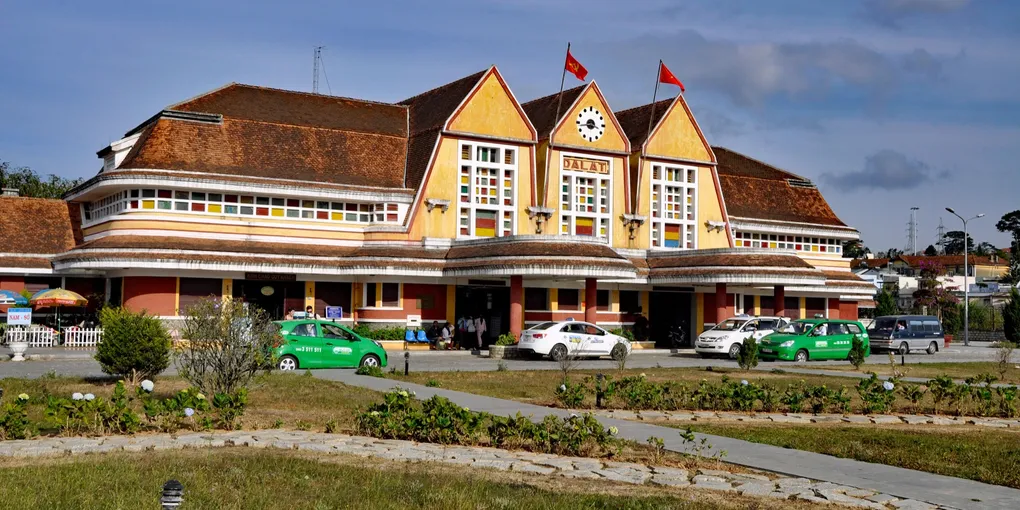
Every other place in this series earned its existence over centuries: a river port, a dynastic capital, a trading town. Đà Lạt did not. It was decided. On 21 June 1893 Alexandre Yersin — the Swiss-French doctor who, a year later, would identify the plague bacillus — climbed out of the forest onto the Lang Biang plateau, some 1,500 metres above the coast, and found air that felt like Europe. Four years on, Governor-General Paul Doumer, who wanted a hill station like the ones the British kept in India, took up the idea: a place where colonial officials could flee the Sài Gòn heat, eat strawberries, and pretend for a fortnight that they were somewhere else. The town took decades to build — its railway only reached the plateau in 1938 — but the original brief never changed. Đà Lạt is a city whose entire purpose is to not be the rest of Việt Nam.
That is worth holding onto, because it explains both what is wonderful here and what has gone wrong. The Vietnamese adopted the French idea wholesale — honeymooners from Sài Gòn, students on a long weekend, families escaping the delta’s heat — and in the last decade the “somewhere else” has been industrialised: fake Dutch windmills, Swiss chalets, a Bali swing or two, farms whose real crop is selfies, all marketed as “check-in points”. The standard complaint, that Đà Lạt has become kitsch, misses that it was always a stage set. The trick is to choose the older set.
What was actually built
Start at the lake. Hồ Xuân Hương, the oval of water the whole city is arranged around, is artificial — the French dammed the Cam Ly stream in 1919 — and walking its roughly five-kilometre shoreline early, before the swan pedalos launch, is the best orientation you can get: pine-covered hills, the old Dalat Palace hotel above, mist burning off. Then go to the railway station, built 1932–38 to a design by the architects Moncet and Revéron, with three steep gables meant to echo the peaks of Lang Biang. Most of the 84-kilometre cog railway down to Tháp Chàm on the coast was abandoned after the war, but a seven-kilometre stub to Trại Mát still runs a few times a day (and on Friday–Sunday evenings), ending at the mosaic-covered Linh Phước pagoda. It is a tourist ride and it knows it; it is still the most honest half-hour in town.
From there the French and imperial layer is scattered across the hills: the Pasteur Institute, the Domaine de Marie convent, the summer palace of Bảo Đại — the last emperor, who spent more time hunting around here than ruling — and the former Lycée Yersin, now a teachers’ college with a long curved brick façade. None of it is a must; all of it rewards a slow afternoon on a rented motorbike. The “Crazy House”, Hằng Nga’s concrete tree-guesthouse, is the one newer attraction I would keep: it is genuinely strange rather than borrowed.
The weather is the attraction
The thing the French came for is still the thing. Days hover around 22–24°C all year; nights in December and January can drop towards 10°C, which in southern Việt Nam counts as an event. People come here to wear a jacket. Hot soy milk with a bánh tiêu at the night market, drunk in a scarf, is a ritual precisely because nowhere else in the south makes it make sense. Order it, then the food the altitude produces: bánh căn (little rice-flour cakes with a quail egg, dipped in a bowl with a pork meatball), bánh ướt lòng gà (fresh rice sheets with chicken offal, oddly good), lẩu gà lá é (chicken hot pot with a lemony basil that grows up here — the dish was borrowed from Phú Yên and nobody is giving it back), bánh tráng nướng off a charcoal grill, strawberries, artichoke tea, and coffee from the farms out at Cầu Đất.
For a view, Lang Biang: a jeep hauls you up to Radar Hill at 1,929 metres in fifteen minutes; the true summit, a couple of hundred metres higher, is a half-day hike through pine forest. And ride the roads — the Prenn and Mimosa passes off the plateau, or west through Tà Nung towards the Elephant waterfall — which in November are lined with dã quỳ, the yellow wild sunflower that is the real reason to come this month.
The honest part
Đà Lạt’s climate is also what is eating it. The valleys north and east of the centre are roofed in white plastic — greenhouses for the flowers and vegetables that feed the whole country — and parts of the city now flash-flood after heavy rain because the ground can no longer absorb it. The province has a plan to push greenhouses out of the inner city by 2030; from the Lang Biang jeep you can see how far it has to go. The Prenn pass, the main road up from the airport, slid badly in November 2025 and has been closed for repairs more than once since; check road news before driving it in the wet (the Mimosa pass is the fallback). And weekends, Tết, and the 30 April holiday turn the centre into a traffic jam of Sài Gòn plates. Come midweek if you can.
Practical notes
Getting there. Liên Khương airport is about 30 km south of the centre. It reopened on 19 August 2026 after five months closed for a runway rebuild, with flights from Hà Nội (about 1h50) and Sài Gòn (under an hour). The airport shuttle bus costs around 40–50,000 VND and takes 40 minutes or so; a taxi is roughly 300,000. Sleeper buses from Sài Gòn (Phương Trang/FUTA and many others) take 6–8 hours for about 300 km over the Bảo Lộc pass, from roughly 300,000 VND; the expressway that would halve that is still under construction, with 2027 as the optimistic date. From Nha Trang it is about 135 km and 3–4 hours over the Khánh Lê pass, one of the best mountain roads in the country.
How long. Two nights is right; three if you want Lang Biang and a coffee farm. Rent a motorbike — the city is hilly, so it is not a bicycle town.
When. Dry season is December–March, with the clearest skies and the coldest nights. November is the hinge: foggy mornings and some afternoon rain, but the dã quỳ bloom from late October to the end of the month. The eleventh Đà Lạt Flower Festival runs 19–31 December 2026 — spectacular, and the hotels fill, so decide which you want. Cherry blossom (mai anh đào) comes in January–February. May to October is the rainy season; avoid it.
One administrative note. Since 1 July 2025 Đà Lạt is no longer a city on paper: it is five wards (Xuân Hương, Cam Ly, Lâm Viên, Xuân Trường and Lang Biang, each with “– Đà Lạt” appended) of an enlarged Lâm Đồng province that now reaches the coast at Phan Thiết. The provincial seat is still here, and nobody in Đà Lạt calls it anything but Đà Lạt.
Cover photo: Đà Lạt railway station by P. Hughes, CC BY 4.0, via Wikimedia Commons.
