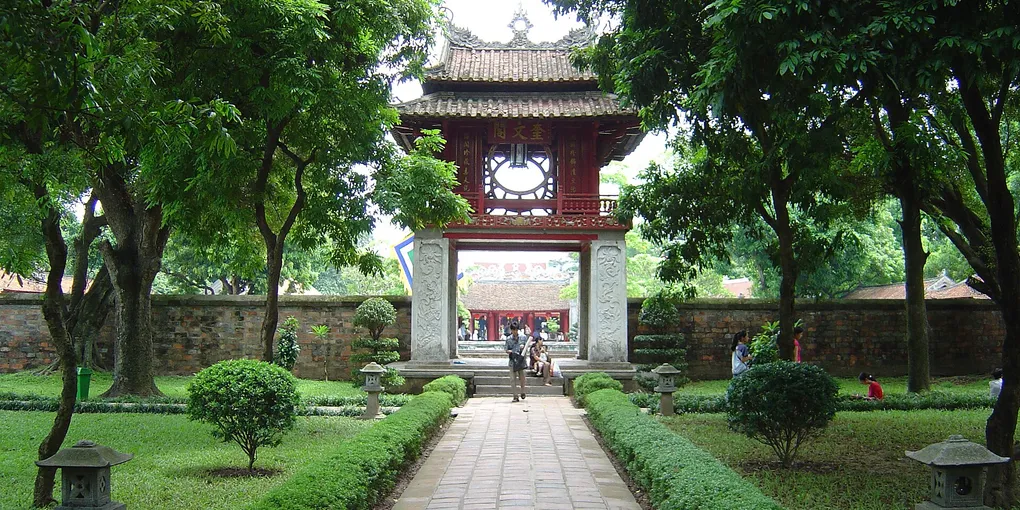
The 82 doctoral steles at the Temple of Literature in Hà Nội list about 1,300 people who passed the country’s highest examination. They say much less about the people who ran the school. The Imperial Academy (Quốc Tử Giám), founded in 1076, had a head and a deputy for most of its history, and a number of the best-known scholars in Vietnamese history held one of the two posts.
Two titles: Tế tửu and Tư nghiệp
The head of the Academy was the Tế tửu (祭酒). The title is borrowed from Chinese court usage. It literally means “the one who offers the wine”, after the custom that the most senior person at a ritual poured the libation. In practice the Tế tửu was the rector: he ran teaching, looked after the students, and took part in the examinations. His deputy was the Tư nghiệp (司業).
The ranking between the two changed over time. Under the Trần, the Tư nghiệp was the senior academic post at the Academy and in practice its head. Under the early Lê in the fifteenth century, the Tế tửu became the head and the Tư nghiệp became his deputy. Vietnamese researchers have compiled biographies of roughly a hundred known holders of the two posts up to the end of the Lê period. Published counts differ (97 in one, 103 in another). The temple today displays a numbered board of known holders, compiled by modern researchers since no complete list survives from the dynasties themselves. What follows are the best-documented of them, not a full roll.
Chu Văn An: the teacher who walked out
The best-known name is Chu Văn An (1292–1370). He ran a private school, the Huỳnh Cung school, in his home village south of Thăng Long. King Trần Minh Tông called him to court as Tư nghiệp of the Quốc Tử Giám and made him tutor to the crown prince Trần Vượng, the future King Trần Hiến Tông. He wrote a summary of the Confucian Four Books, the Tứ thư thuyết ước, which was used for teaching. The text has not survived.
He is remembered more for how he left. Under King Trần Dụ Tông, as the court declined, he sent up the Thất trảm sớ, a memorial asking for the execution of seven corrupt courtiers. The king did not act on it. Chu Văn An resigned and went back to teaching in the mountains of Chí Linh, where he died in 1370. That year King Trần Nghệ Tông gave him the posthumous title Văn Trinh and had him worshipped in the Temple of Literature. He was the first Vietnamese scholar to be enshrined there next to Confucius and his disciples. He is still honoured at the temple, and Vietnamese schools call him “vạn thế sư biểu”, the model teacher for all generations.
He was not the only well-known Tư nghiệp. Under the short-lived Hồ dynasty (1400–1407), Nguyễn Phi Khanh, the father of Nguyễn Trãi, held the post at the same time as a seat in the Hàn lâm academy.
The early Lê: the stele and the rector
Under the early Lê the post of Tế tửu sits right next to the history of the steles.
Nguyễn Trực (1417–1474) came first in the palace examination of 1442, so he was the first trạng nguyên of the Lê dynasty. His name is at the top of the first doctoral stele. Family tradition calls him “lưỡng quốc trạng nguyên”, top laureate of two countries, from a story about an envoy mission to China. Treat that as tradition, not record. The well-attested part is his career: in 1463 King Lê Thánh Tông made him Hàn lâm thừa chỉ and Tế tửu of the Quốc Tử Giám.
The 1442 stele itself was not carved until 1484. The text was written on royal order by Thân Nhân Trung (born 1418 or 1419, died 1499). He had come first in the metropolitan exam of 1469, became deputy leader of the king’s Tao Đàn poetry society, and held the post of Tế tửu alongside his higher offices. The best-known sentence in Vietnamese education, “worthy talent is the vital energy of the nation”, was written by a serving head of the Academy. He was writing about an exam whose top laureate had held the same post twenty years earlier.
The historian Ngô Sĩ Liên, a laureate of the same 1442 exam and the compiler of the Đại Việt sử ký toàn thư, also served as Tư nghiệp.
The restored Lê: fathers, sons and repairs
After the Lê–Mạc wars the post continued under the restored Lê and the Trịnh lords, who held real power. Three careers show how it worked in that period.
Nguyễn Phùng Thời (1684–1754), from Nghệ An, earned his doctorate in 1715 and was made Tế tửu in 1736. His son Nguyễn Bá Quýnh (1710–1772) earned his doctorate in 1733 and served as Tư nghiệp. Father and son held the Academy’s top two titles, which happened very rarely.
Nhữ Đình Toản (1703–1773), also known as Nhữ Công Toản, from Hoạch Trạch village in Hải Dương, came from a rare dynasty of laureates: his grandfather Nhữ Tiến Dụng and his father Nhữ Đình Hiền were both doctoral laureates, his elder brother Nhữ Trọng Thai was a Bảng nhãn (second place in the palace exam), and his son Nhữ Công Chấn would later earn the title of Hoàng giáp (a doctorate of the second rank). He came first in the metropolitan exam of 1736, so his name is on the stele for that year. Much of his career was spent outside the capital. In 1741, while serving as a provincial governor against rebel forces, he was captured, and he talked the rebel commander into surrendering. That episode won him the trust of Lord Trịnh Doanh. He rose to Tham tụng, the equivalent of a prime minister (tể tướng), who ran the whole business of government under the Trịnh lord, and to Minister of War, and served as Tế tửu of the Quốc Tử Giám. On the numbered board of rectors at the temple he is number 78. He cared about the exams themselves: in 1751 he pushed for changes to how exam essays were set and written, and on royal order he composed the inscriptions on two of the steles, for the exams of 1752 and 1757. Among his students was the scholar and historian Ngô Thì Sĩ (1726–1780) (Ngô Thì Sĩ was the father of the scholars Ngô Thì Nhậm, Ngô Thì Chí, Ngô Thì Trí and Ngô Thì Hương, and the father-in-law of Phan Huy Ích). He died in 1773 and was posthumously made Thái bảo.
Vũ Miên (1718–1782), from Kinh Bắc, came first in the metropolitan exam of 1748. He held the post of Tế tửu from 1767 to 1780, about thirteen years, under Lord Trịnh Sâm. With the senior officials Nguyễn Nghiễm and Nguyễn Hoản he repaired the Thái Học buildings and had the Bích Ung bell cast. He also worked on the Đại Việt lịch triều đăng khoa lục, the register of exam laureates through the dynasties. His tenure ended in 1780, the same year the last of the 82 steles was set up.
The polymath Lê Quý Đôn (1726–1784), who came second in the palace exam, also served as Tư nghiệp in this period.
Huế: the post moves south
The Nguyễn dynasty moved the capital to Huế. A school there called the Đốc học đường opened in 1803, and King Minh Mạng renamed it Quốc Tử Giám in 1820. It kept the same two posts, Tế tửu at the head and Tư nghiệp as deputy.
The usual rule was that a Tế tửu had to hold at least a doctorate. One known exception is Nguyễn Thuyên (1790–1853), from Nam Định. He passed only the provincial tú tài level three times (1816, 1819, 1822) and earned his cử nhân degree on the fourth try in 1825. After years as a provincial education officer, during which his students included three thám hoa and seventeen doctors, he became Tư nghiệp in 1841, and King Thiệu Trị made him Tế tửu in 1846. The court picked him for his teaching record, not his degree.
The Huế Academy moved inside the Citadel in 1908 and stopped operating in 1945 when the monarchy ended. That was the end of the title Tế tửu.
Today: a heritage centre, not a rector
The Hà Nội site no longer has a Tế tửu. Since 25 April 1988 it has been run by the Văn Miếu – Quốc Tử Giám Centre for Cultural and Scientific Activities, set up by decision 1776/QĐ-UB of the Hà Nội People’s Committee and now under the city’s Department of Culture and Sports. It started with eight staff and had 93 by 2018.
Its directors are heritage managers, not scholars of the classics. Some have still left a mark. Nguyễn Quang Lộc, a librarian and novelist, joined in 1988, became deputy director in 1990 and director in 1996. He oversaw the restoration of the Confucian statues and the rebuilding of the Thái Học. During his time, visitor numbers grew from about 5,000 a year to more than a million. A 2006 newspaper profile called him, half in jest, “the Tế tửu of Văn Miếu”. Lê Xuân Kiêu took over management of the site in 2016 and is the current director.
This year, 2026, is the Academy’s 950th anniversary. The steles record who passed the exams. The list of rectors, from a fourteenth-century teacher who resigned over a petition to a twenty-first-century administrator managing a million visitors a year, records who looked after the institution.
Sources
- Quốc tử giám — Wikipedia tiếng Việt
- Chu Văn An — Wikipedia tiếng Việt
- Chu Văn An, Trương Hán Siêu và Đỗ Tử Bình được vua Trần cho thờ ở Văn Miếu — VnExpress
- Những bậc thầy tiêu biểu của Quốc Tử Giám qua các triều đại — CafeBiz
- Nguyễn Trực — Wikipedia tiếng Việt
- Tấm bia tiến sĩ đầu tiên và bài ký của Thân Nhân Trung — Người Hà Nội
- Tiến sĩ Thân Nhân Trung — Cổng thông tin tỉnh Bắc Giang
- Cha giữ chức Tế tửu, con làm Tư nghiệp Quốc Tử Giám — Dân Việt
- Hội nguyên Tiến sĩ Nhữ Đình Toản — danh thần toàn tài xứ Đông — VOV2
- Nhữ Đình Toản và giai thoại tiền hóa thành đất — Dân Việt
- 82 văn bia tại Văn Miếu Hà Nội (khoa 1757) — Họ Ninh Việt Nam
- Ngô gia văn phái — Wikipedia tiếng Việt
- Ngô Thì Sĩ (1726–1780) — Cổng thông tin phường Buôn Hồ
- Tế tửu Quốc Tử Giám Vũ Miên — Bảo tàng Lịch sử Quốc gia
- Danh nho nào chỉ đỗ Cử nhân vẫn được chọn làm Tế tửu Quốc Tử Giám? — Dân Việt
- Chỉ đỗ Cử nhân vẫn được chọn làm Tế tửu Quốc Tử Giám — Giáo dục & Thời đại
- Quốc Tử Giám (Huế) — Wikipedia tiếng Việt
- Trung tâm Hoạt động Văn hóa Khoa học Văn Miếu – Quốc Tử Giám, 30 năm xây dựng và phát triển — Thế giới Di sản
- Ông “quan tế tửu” Văn Miếu – Quốc Tử Giám — Công an Nhân dân
Cover photo: Khuê Văn Các, the Constellation of Literature pavilion, Temple of Literature, Hà Nội by Chuoibk, CC BY-SA 3.0, via Wikimedia Commons (resized).
