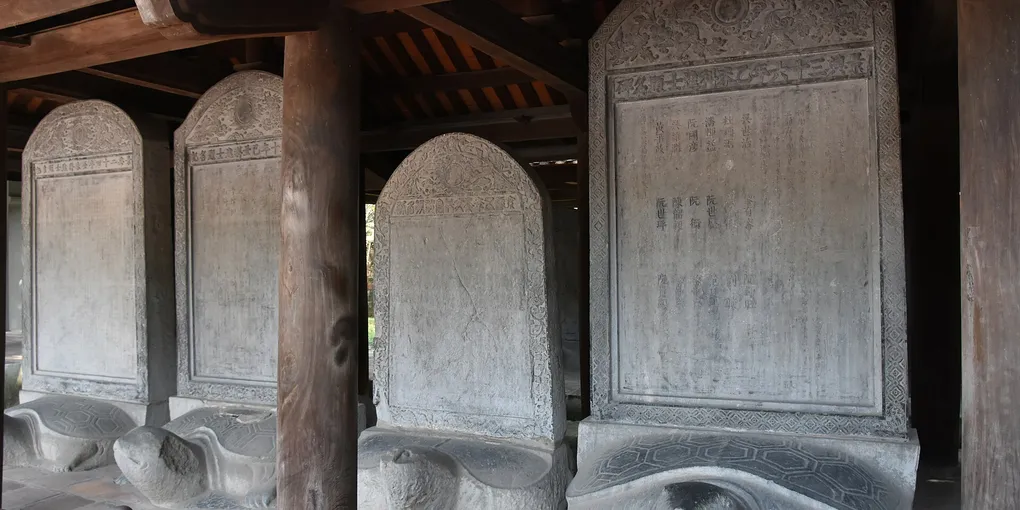
Walk through the third courtyard of the Temple of Literature (Văn Miếu – Quốc Tử Giám) in Hà Nội and you pass two long rows of stone slabs, each riding on the back of a stone turtle. There are 82 of them. Taken together they are something unusual: a public record, kept for more than three centuries, of who passed the country’s highest examination.
A temple, then a school
The site is older than the steles. In 1070, under King Lý Thánh Tông, a temple to Confucius was built here, the Văn Miếu. In 1076 his successor Lý Nhân Tông founded the Quốc Tử Giám, the Imperial Academy, next to it. At first the Academy taught the sons of the royal family and the aristocracy. Over time it became the top of a national education system. The Confucian civil-service examinations fed into it and were in turn fed by it.
For roughly four centuries, though, passing the top exam brought rank and office but no permanent public monument. That changed with one king.
Lê Thánh Tông’s decision of 1484
In 1484, Lê Thánh Tông (r. 1460–1497) ordered that the names of the doctoral laureates (tiến sĩ) be carved on stone steles and set up at the Temple of Literature. The record did not begin with his own reign. It reached back to the examination of 1442, the Nhâm Tuất exam in the third year of the Đại Bảo era under Lê Thái Tông. A first batch of steles went up that year.
Each stele carries more than a list of names. The inscription (bài ký), written in classical Chinese, records the date of the exam, how it was run, the examiners, and the laureates with their home villages. Most also carry a short essay on why the state honours learning. The most famous comes from the 1442 stele, composed by the scholar-official Thân Nhân Trung:
“Hiền tài là nguyên khí của quốc gia” — worthy talent is the vital energy of the nation. When that energy is strong the country rises; when it weakens the country declines.
Every Vietnamese student meets that sentence in school, and it now appears on banners at graduation ceremonies. Its original setting was political as well as moral. A dynasty that had recently expelled the Ming (1428) was saying in public, and in stone, that it would be governed by people chosen on merit.
Carving by campaigns
The steles were not added neatly one exam at a time. They came in waves, and the waves follow the country’s upheavals:
- 1484 to the 1530s: the early Lê steles. They are smaller and plainer, with slim, restrained turtles. One stele from this era honours an examination held under the Mạc dynasty, which seized the throne in 1527.
- 1653: after decades of civil war between the Mạc and the restored Lê, the court carved a large batch at once. This was a catch-up campaign to put the missing exams back on the record. Heritage specialists consider these the most richly decorated steles.
- 1717 onward: a second large campaign, followed by steady additions. The last stele was erected in 1780 for the exam of 1779.
The turtles change with the carving. Early ones are lean and long-necked. Later ones are heavier and rounder, with bulging eyes and thick shells. Art historians use these differences, together with the decoration on the curved tops of the steles, to date the stones.
In total the steles name about 1,300 laureates (sources count between 1,304 and 1,307). Among them are figures familiar from textbooks, such as the historian Ngô Sĩ Liên and the eighteenth-century polymath Lê Quý Đôn. Not every examination from those centuries survives in stone. Some steles were probably never made and others were lost, so the 82 are what remains, not a complete set.
Why a turtle?
The turtle is one of the “four sacred creatures” (tứ linh) of Vietnamese and wider East Asian symbolism, alongside the dragon, the unicorn and the phoenix. It stands for longevity and endurance. Putting a laureate’s name on a turtle’s back was a way of saying the honour would last. A popular custom grew up among students of rubbing the turtles’ heads for luck before exams. This is folk practice, not a historical rite. The rubbing wore the stone down, and the steles are now kept behind low railings. Visitors look but do not touch.
After the capital moved
The Nguyễn dynasty moved the capital to Huế in 1802, and the Imperial Academy moved there in 1803. Nobody added to the Hà Nội steles after 1780, so the collection stops with the Lê. Confucian examinations continued in Huế until they were abolished in 1919.
In 2010 UNESCO added the 82 steles to its Memory of the World Asia-Pacific register, and in 2011 to the international register. UNESCO recognised them as documents, not as monuments: they are an archive of how a state chose its officials, kept in stone because stone was meant to outlast everything else.
That is also why they still matter. Before exam season, students still come to the temple to light incense, now that they can no longer rub the turtles. The steles record a simple idea that a fifteenth-century king thought was worth carving: talent should be recognised, recorded, and remembered by name.
Sources
- Stone Stele Records of Royal Examinations of the Lê and Mạc Dynasties (1442–1779) — UNESCO Memory of the World
- Temple of Literature, Hanoi — Wikipedia
- Bia Đề danh tiến sĩ tại Văn Miếu – Quốc Tử Giám — Cục Di sản văn hóa
- Bia Tiến sĩ Văn Miếu — Di sản tư liệu thế giới — Người Việt Nam, TTXVN
- Bia tiến sĩ Văn Miếu Thăng Long — Wikipedia tiếng Việt
Cover photo: Tortoise stelae, Temple of Literature, Hanoi, 15th–18th centuries by Richard Mortel, CC BY 2.0, via Wikimedia Commons.
