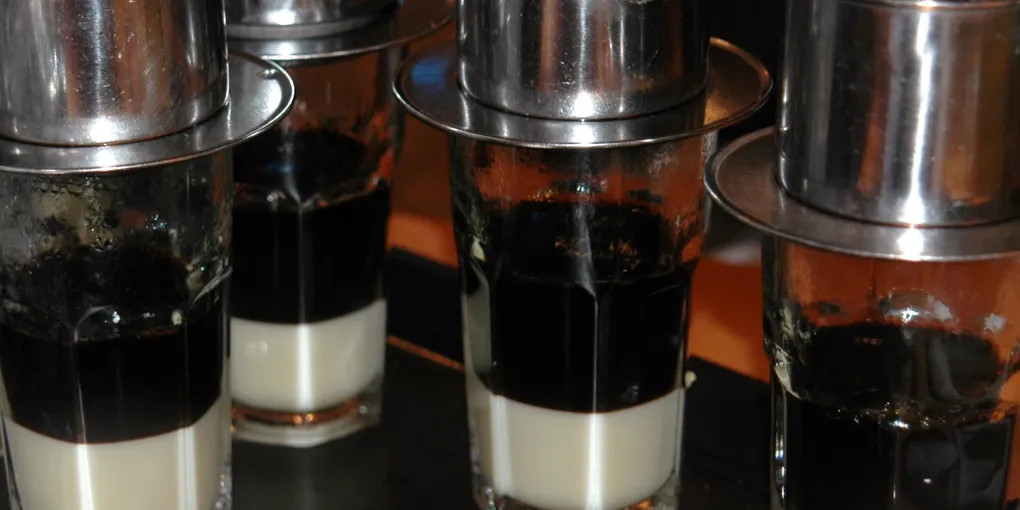
The first thing a visitor notices about Vietnamese coffee is that it will not be rushed. You order a cà phê sữa đá, and what arrives is not a drink but a small apparatus: a dented aluminium cup perched on a glass, a centimetre of condensed milk pooled at the bottom, and a slow black drip falling into it. You wait. Nobody around you seems to mind. That wait — five minutes, sometimes more — is the whole culture in miniature.
A French import that went native
Coffee arrived with French Catholic missionaries in 1857, and the first plantations were set up in the north in the late 1880s, in places like Ninh Bình and Quảng Bình. The north turned out not to be ideal. In the early twentieth century the colonial administration opened coffee zones in the Central Highlands, above all around Buôn Ma Thuột in Đắk Lắk, where the red basalt soil suited the hardy robusta plant far better than delicate arabica.
The war years and post-war collectivisation all but stalled the industry. Then came Đổi Mới, the 1986 reforms that let private farmers plant and sell again, and the Highlands filled with coffee almost within a generation. Vietnam is now the world’s second-largest coffee producer after Brazil, and robusta makes up roughly 97% of its output. That matters for the cup: robusta is more bitter, more full-bodied and carries nearly twice the caffeine of arabica. Vietnamese coffee tastes like it does partly because of geology.
The phin and the condensed milk
The phin is a cheap, clever piece of kit — a perforated cup, a press plate that sits on the grounds, a lid, and a flat base that rests across the rim of a glass. Hot water goes in, and gravity does the rest, slowly. It needs no electricity and no machine, which is exactly why it spread through every street stall in the country.
The condensed milk has a practical story behind it. Fresh milk was scarce and spoiled fast in the tropical heat before refrigeration; tinned sweetened condensed milk kept for months. That, at least, is the usual explanation, and it is a plausible one. What’s certain is the result: dark, bitter robusta cut with thick sweet milk, then poured over a glass of ice in the south, or drunk hot in the cooler north. Cà phê đen is black; cà phê sữa is with milk; add đá and it’s iced. In Sài Gòn you’ll also hear bạc xỉu — mostly milk, a little coffee — a term that came from the city’s Cantonese community.
The phin was not the only method. Old Sài Gòn’s Chinese-run stalls brewed cà phê vợt, “sock coffee,” straining it through a long cloth filter. Cheo Leo, tucked into an alley in District 3, has been making it that way since 1938 and is usually cited as the oldest café still running in the city.
Egg coffee, salt coffee
Two signature drinks were invented out of necessity or ingenuity, and both have documented inventors.
Cà phê trứng (egg coffee) was created in 1946 in Hà Nội by Nguyễn Văn Giảng, then a bartender at the Métropole hotel. Milk was scarce during the war with France, so he whisked egg yolk with sugar and condensed milk into a thick cream to float on the coffee — something close to a cappuccino, made from what was available. He went on to open his own café, Cà phê Giảng; it still operates at 39 Nguyễn Hữu Huân in the Old Quarter, run by his youngest son. The drink tastes, if you’ve never had it, a bit like liquid tiramisu.
Cà phê muối (salt coffee) is much younger. It came out of a small shop in Huế around 2010, where a couple topped condensed-milk coffee with a lightly salted cream. The salt doesn’t make it salty so much as rounder, cutting robusta’s bitterness. It stayed a Huế thing for years, then spread to Đà Nẵng and Hội An, then to Hà Nội and Sài Gòn, and by the mid-2020s to cafés abroad.
The plastic stool is the point
For all the drinks, the real Vietnamese coffee culture is about sitting. The classic café is a row of low plastic stools on a pavement, facing the street rather than each other, so the customers watch the traffic like a slow film. People go before work, at lunch, after lunch, in the late afternoon. Business gets done over coffee; so does gossip, homework, idle chess, and a lot of looking at nothing in particular. A glass of free trà đá (iced tea) usually comes alongside, and nobody asks you to leave.
The modern chains — with air conditioning, Wi-Fi and oat milk — are everywhere now, and Hà Nội and Sài Gòn have a serious specialty scene. But the stool-on-the-pavement café has not gone anywhere. It is still where a city takes its pulse, one slow drip at a time.
If you’re visiting: order a phin, and don’t touch it until it stops dripping. Then stir hard, pour it over the ice, and settle in. You aren’t in a hurry. Neither is anyone else.
Sources
- Coffee production in Vietnam — Wikipedia
- Brewing Billions: Vietnam’s coffee economy — Heinrich Böll Foundation
- An Unfiltered History of Vietnamese Coffee — Barista Magazine
- Cà phê Giảng — Wikipedia tiếng Việt
- Vietnamese egg coffee — Atlas Obscura
- Why Vietnam’s salt coffee is catching on — CNN
- 80 years of cà phê vợt in Saigon’s oldest café — Saigoneer
Cover photo: phin filters dripping over condensed milk by The Hippie Triathlete, CC BY 2.0, via Wikimedia Commons.
