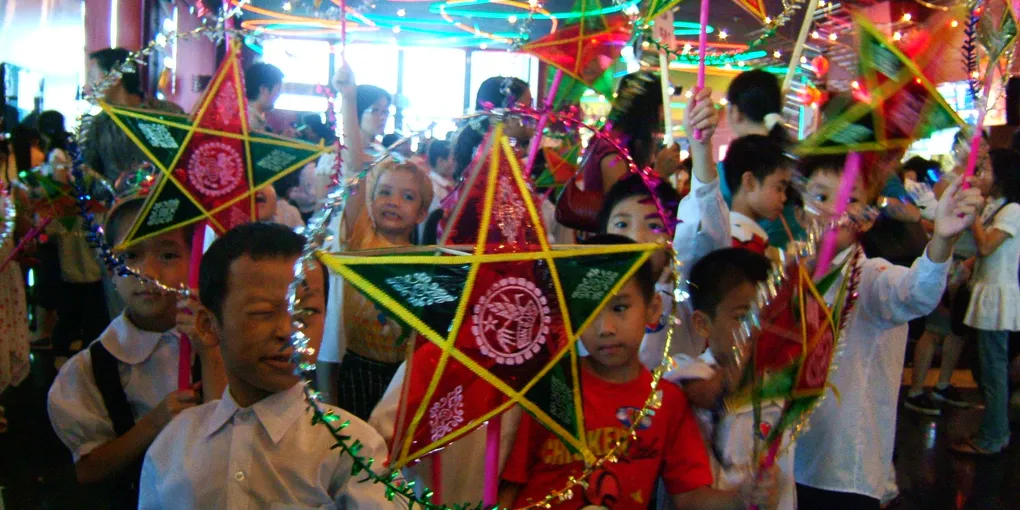
On the fifteenth night of the eighth lunar month, the streets of any Vietnamese town fill with small processions. Children walk in loose lines behind a drum and a cardboard lion’s head, each holding a five-pointed star of bamboo and red cellophane on a stick, with a candle (these days, more often a battery bulb) flickering inside. Adults trail behind holding phones and spare candles. Later there will be mooncakes and tea, and somebody’s grandmother will point at the dark patch on the moon and say that’s Cuội, sitting under his banyan tree.
Much of East Asia celebrates the Mid-Autumn Festival. In China it is mainly about family reunion, and in Korea Chuseok is a harvest holiday spent at ancestral graves. Vietnam turned it into something else: Tết Trung Thu is the children’s festival. Many Vietnamese adults simply call it Tết thiếu nhi.
A festival with a long and argued-over past
Where the festival came from is still debated. The usual scholarly view, followed by English Wikipedia, is that it arrived from China, where moon-watching on the fifteenth of the eighth month took off under the Tang dynasty (618–907). Some Vietnamese writers argue for a much older local root in the wet-rice calendar of the Red River delta, pointing to scenes cast on Đông Sơn bronze drums. Take that as a hypothesis rather than a settled fact. The drums show festivals, but nobody can show which festival.
What can be documented is royal. An exhibition by the Thăng Long Imperial Citadel heritage centre traces Mid-Autumn as a state occasion back to the Lý dynasty, when the court marked it with ancestral rites, boat races and water puppet shows. Under the Trần, nobles drank wine and traded verses beneath the moon. By the Lê–Trịnh period, the Trịnh lords’ palace in Thăng Long was strung with elaborate lanterns. The scholar Phạm Đình Hổ (1768–1839), looking back in his Vũ trung tùy bút, described the Mid-Autumn lantern displays in the Trịnh palace as one example of how far the lords’ extravagance had gone.
The farmers’ moon
In the villages the full moon was also a forecast. Phan Kế Bính, whose Việt Nam phong tục (early 20th century) is still the standard account of northern customs, describes 19th-century households making offerings to their ancestors by day and setting out a moon-watching feast at night. People studied the moon closely. A proverb still repeated today goes “Muốn ăn lúa tháng Năm, trông trăng rằm tháng Tám”: if you want to eat the fifth-month rice, watch the full moon of the eighth month. Folk belief held that a clear or golden moon favoured silkworms and a hazy one favoured the next rice crop, while a greenish tint warned of storms. These were rules of thumb, not astronomy. They do show that the night was about the harvest long before it was about children.
Cuội and the moon
Every Vietnamese child learns the legend of chú Cuội. In the commonest telling, Cuội was a woodcutter who found a banyan tree whose leaves could bring the dead back to life. He was told never to water it with dirty water. One day it was watered with dirty water anyway (versions differ on who did it), and the tree began to uproot itself and float skyward. Cuội grabbed its roots and was carried all the way to the moon, where he still sits. The Chinese moon goddess Hằng Nga, chị Hằng to children, shares the moon with him in many songs. Cuội, though, is a local character: a bit of a liar and a fool in some stories, and lonely in all of them.
What the night is made of
Lanterns. The đèn ông sao (star lantern) is the icon: five points of split bamboo covered in coloured paper or cellophane, with tassels at the tips. More special is the đèn kéo quân, a lantern with an inner drum that turns in the rising heat of a candle and throws a shadow parade of figures onto its paper walls. The early figures were horses and soldiers, and later came scholars returning in triumph from the court exams. A few villages still make them by hand, including Đàn Viên in Hà Nội and Mật Sơn in Thanh Hoá. There are also carp lanterns, rabbit lanterns, and in Hội An the silk lanterns now famous year-round. In Sài Gòn’s Phú Bình neighbourhood, lantern workshops turned out more than half a million Mid-Autumn lanterns a year between 1960 and 1975.
Toys. Papier-mâché masks, tò he (figures of coloured rice dough, shaped on a stick while you watch), little hand drums called trống bỏi, and under the Nguyễn dynasty the ông Tiến sĩ giấy, a paper “doctoral laureate” given to children as a hint about where their studies should lead. In the lean subsidy years of 1976–1986 families in the north made most of these themselves, and many people now in their fifties remember cutting their own star frames.
The tray. The centrepiece of a traditional northern Mid-Autumn tray is not a mooncake. It is a dog made of pomelo segments, with two black beans for eyes, surrounded by fruit, bánh nướng (the baked mooncake) and bánh dẻo (the soft, white, unbaked one made from roasted glutinous-rice flour). Children “break the feast” (phá cỗ) when the moon is high.
How it became the children’s night
The change was gradual, but one moment marks it. On 17 September 1945, two weeks after independence was declared, Hồ Chí Minh wrote a Mid-Autumn letter “to the dear children” that opens: “Hôm nay là Tết Trung thu. Mẹ đã sắm cho các em nào đèn, nào trống…” (Today is Mid-Autumn. Mother has bought you lanterns, drums…). He wrote to children again at many Mid-Autumns after that: 1948, 1949, through the resistance war, and 1954, which he called the first Mid-Autumn of peace. The closing verse of his 1952 letter later became the traditional song of the Hồ Chí Minh Young Pioneers. Schools and youth organisations took over the lantern parades, and the festival’s centre of gravity moved firmly to the young.
Where to see it now
In Hà Nội, Hàng Mã street in the Old Quarter turns red and gold in the weeks before the full moon and becomes so crowded that it is hard to walk. Star lanterns are still the best seller, alongside masks and tò he. In Tuyên Quang, the Thành Tuyên Festival grew from neighbourhood-built giant lanterns into the country’s largest Mid-Autumn parade. It received trademark protection in 2024, and the 2026 edition ran from 19 to 25 September. Phan Thiết (now part of Lâm Đồng province after the 2025 merger) has its own long-running school lantern procession, which once set a national record for size.
Purists complain, with some reason, that expensive mooncake gift boxes have turned the festival into a corporate one. But walk down any lane on the fifteenth night and the core of it is still there: a child, a paper star, a candle, and a moon with someone sitting in it.
Sources
- Mid-Autumn Festival — Thăng Long Imperial Citadel online exhibition
- Tết Trung Thu — Wikipedia and Tết Trung thu — Wikipedia tiếng Việt (citing Phan Kế Bính, Việt Nam phong tục)
- Time to bring back those lanterns and moon cakes for kids — VOV
- Đọc lại những bức thư Trung thu của Bác Hồ — Nhân Dân
- From lantern parade to national cultural brand — Việt Nam News
- Đồ chơi Trung thu “made in Việt Nam” lên ngôi ở phố Hàng Mã — Thanh Tra
Cover photo: children with star lanterns at a Tết Trung Thu procession by Viethavvh, public domain, via Wikimedia Commons.
