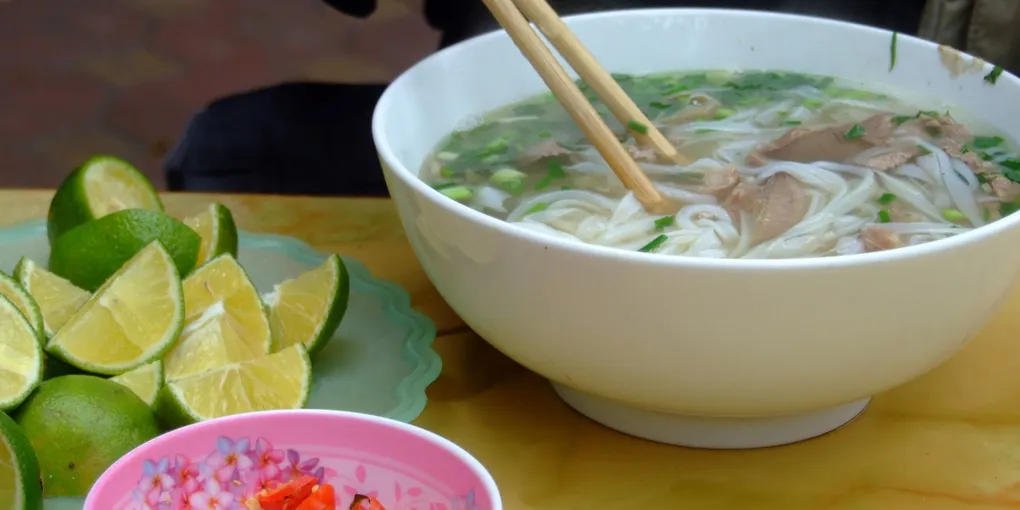
Ask a Hanoian where to eat phở and you will not get a recommendation; you’ll get an argument. This street, not that one. Clear broth, never cloudy. No bean sprouts — what are you, a southerner? Ask someone from Sài Gòn and you will get the opposite argument with equal conviction. For a dish that is, on paper, just rice noodles, beef and broth, phở carries a remarkable amount of history and feeling. That is because it has lived through almost every chapter of modern Vietnam.
A young dish with a disputed birth
Phở is younger than most visitors assume. It doesn’t appear in the early Vietnamese dictionaries of the 1890s; the word turns up in print in the first years of the twentieth century, and the first dictionary to define it was the Việt Nam tự điển of the Khai Trí Tiến Đức society, dated 1930 or 1931 depending on the source — “small slices of rice cake boiled with beef.” The writer Nguyễn Công Hoan later recalled phở being sold on the street around 1913.
Where it came from is genuinely contested, and honest accounts present it as a set of theories rather than a fact:
- Nam Định. The villages of Vân Cù and Dao Cù in Nam Định province, southeast of Hà Nội, are traditionally called the home of phở, and many phở cooks in Hà Nội trace their families there. Nam Định was then a busy textile town, full of workers who needed a cheap, hot, filling breakfast.
- The French connection. Beef was not a big part of the Vietnamese diet before colonial rule — cattle and buffalo were working animals. French demand for steaks left butchers with bones and scraps, which made excellent stock. Some writers derive the word itself from the French pot-au-feu; others find the two dishes too different for that to hold.
- The Chinese connection. Cantonese and Yunnanese workers in the north sold a beef noodle soup, ngưu nhục phấn (牛肉粉), and one popular theory has the street cry “…phấn!” softening into “phở.”
The most likely answer is all of the above: a northern Vietnamese dish shaped by a new supply of beef and by noodle soups that already existed nearby. Vietnamese cooks made it their own — the charred ginger and onion, the star anise and cinnamon, the obsession with a broth so clear you can read through it.
Shoulder poles and chicken days
Early phở was mobile. Vendors carried a gánh phở — a bamboo shoulder pole with a charcoal-heated pot on one end and noodles, meat and bowls on the other — through Hà Nội’s streets, calling out as they went. Fixed shops came later. By 1930 phở tái, with raw slices of beef cooked by the hot broth in the bowl, had appeared.
Phở gà (chicken phở) is usually dated to 1939, when beef was reportedly not sold at markets on certain days of the week. Purists grumbled; the chicken version stayed anyway.
In 1957 the writer Nguyễn Tuân published his essay Phở in two issues of the journal Văn. It reads like a love letter, dissecting the difference between bones still carrying meat and bare ones, and arguing that phở belongs to everyone, rich and poor alike. Generations of Vietnamese students have studied it in school.
North, south, and the bowl with nobody in it
Two events split phở into the styles people argue about today.
In 1954, after the Geneva Accords divided the country, close to a million northerners moved south, many from the Red River Delta — Hà Nội, Hải Phòng, Nam Định. They brought phở with them. In the south, where it had been relatively uncommon, the dish met abundant herbs, sugar and a different palate. Southern phở gained a sweeter broth, plates of bean sprouts, Thai basil and sawtooth herb, wedges of lime, and bottles of hoisin and chilli sauce on the table. Northern phở stayed austere: the broth, the noodles, the meat, spring onion, and perhaps a squeeze of lime, sliced chilli, garlic vinegar — and quẩy, fried dough sticks, for dipping.
In the subsidy years (thời bao cấp) after 1975, private phở shops in the north were folded into state-run outlets. Meat was scarce, and state shops served a bowl of noodles in thin broth with no meat at all. Hà Nội named it with dark wit: phở không người lái, “unmanned phở,” after the American drones of the war years. Older Hanoians still use the phrase, and a proper bowl of phở in those years was something you bought for a sick relative.
After the 1975 exodus, refugees carried the southern style around the world. That is why the phở most foreigners first meet — with the herb plate and the sauce bottles — is the Sài Gòn version, and why some northern visitors abroad barely recognise it.
A bowl that became heritage
Phở today is breakfast, late-night food, and a quiet national symbol. In 2024 the Ministry of Culture added the folk knowledge of both phở Nam Định and phở Hà Nội to the national list of intangible cultural heritage, and work on a UNESCO dossier has begun. Since 2017 the newspaper Tuổi Trẻ has organised a Phở Day on 12 December each year.
None of that changes how it’s eaten. You sit on a low stool, early, while the broth is at its best. You taste before you add anything. You don’t ask for hoisin in Hà Nội. And whichever city you’re in, you agree, firmly, that the other one is doing it wrong.
Sources
- Phở — Wikipedia
- The story of Vietnamese phở — Vietnam National Authority of Tourism
- The Origin Of Phở: How And Where It Began — Vietcetera
- Phở etymology — Language Log, University of Pennsylvania
- “Phở Nam Định” becomes national intangible heritage — Báo Văn hóa
- Phở Hà Nội heritage decision announced — Báo Văn hóa
- Proposal to establish 12 December as Phở Day — Tuổi Trẻ
Cover photo: a bowl of phở bò in Cầu Giấy, Hà Nội by Codename5281, CC BY-SA 3.0, via Wikimedia Commons.
