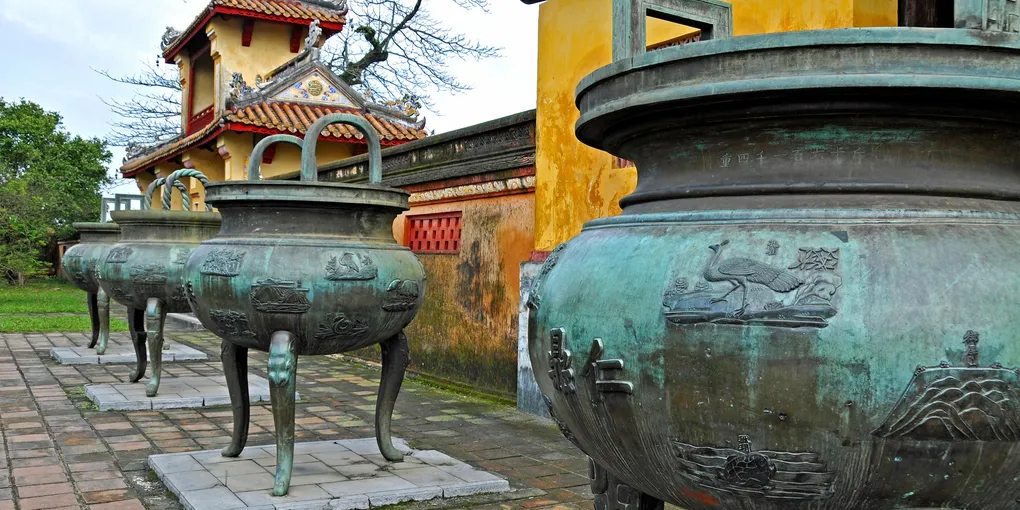
Run your hand along the belly of one of the urns in front of the Thế Miếu in Huế and you can feel a peacock. It stands in low relief, tail trailing behind it, and beside it are two raised Chinese characters giving its name. A little further round the same urn there is a river, then a mountain, then a boat. The bronze has turned the green of old copper, with darker patches where two centuries of rain have run down it. Each urn stands on three legs, on a square block of stone, and there are nine of them in a single row.
They are the Cửu Đỉnh, the Nine Dynastic Urns of the Nguyễn. For nearly two hundred years they have stood in that courtyard of the imperial city and carried something a book of the same age could have carried, but cast in metal: a picture of the country as its emperor wanted it seen.
An idea borrowed from antiquity
The model was ancient and partly legendary. Chinese tradition held that Yu the Great, after taming the floods, divided the world into nine provinces and cast nine bronze tripods (đỉnh) to stand for them. Whoever held the tripods held the mandate. Tradition also says that when the Shang overthrew the Xia, they carried the tripods off to their own capital, and that the Zhou took them again in turn. The story is legend, but its meaning was plain to any Confucian court: a đỉnh was a cooking vessel that had become a symbol of legitimate rule.
Minh Mạng, the second Nguyễn emperor, was a ruler who took such symbols seriously. In the tenth lunar month of the Ất Mùi year, late in 1835, he issued an edict to the Grand Secretariat and the Ministry of Works ordering nine urns for the dynastic temple. The urn, he wrote in the edict recorded in the court annals Đại Nam thực lục, showed that the throne was rightly held and the mandate had settled; it was a treasure that belonged in the ancestral temple.
Clay, fire and a year of work
The urns were cast by the bronze-founders of Huế’s casting quarter, the Phường Đúc, in moulds of carefully chosen clay. Each mould was used once and then broken to release the bronze, so no two urns came out alike, and no copy could be made from the same form. The rough castings were finished in the fifth lunar month of 1836. Then came months more of work on the reliefs and the finishing before the urns were set in place in 1837, at the start of the lunar year by the most-cited account, with Minh Mạng presiding.
They share a family shape: a round belly, a pinched neck, a flared mouth, two handles above and three legs below. Yet no two are identical. Some handles are square, some rounded, one pair twisted like rope; some legs bend at the knee and others drop straight. The largest, the Cao urn, is about 2.5 metres tall and weighs roughly 2.6 tonnes. The smallest, the Huyền urn, is about 2.3 metres and 1,935 kilograms. The weight of each is cast into its neck, and on the other side the year of the order: Minh Mạng thập lục niên, the sixteenth year of Minh Mạng, 1835.
A country in 162 panels
Look at the bellies closely and the purpose becomes clear. Each urn carries eighteen cast panels in three tiers: seventeen images and one bearing the urn’s name. That gives 162 panels across the set, and 153 of them are pictures. Each picture is labelled.
The number nine organises nearly everything. There are nine phenomena of the sky: sun, moon, wind, thunder, cloud, rain, the five planets, the Northern Dipper and the Southern Dipper. There are nine mountains, among them Ngự Bình, which faces the citadel across the Perfume River, as well as Hồng Lĩnh, Tản Viên, Hải Vân and Hoành Sơn. There are nine great rivers, among them the Hương, the Hồng, the Mã, the Lam, the Gianh, the Thạch Hãn and the Bạch Đằng. Then come canals, sea gates and passes, nine beasts, nine sacred creatures, nine birds, nine grains, nine vegetables, nine flowers, nine fruit trees, nine medicinal plants, nine timbers, nine weapons, nine kinds of fish, snail and insect, and nine boats, carts and flags. About ninety of the images are plants and animals. Researchers have called the set an illustrated natural history of early nineteenth-century Việt Nam.
The geography amounts to a claim. The Hải Vân Pass appears on the Cao urn. The three largest urns each carry a sea: the Eastern Sea on Cao, the Southern Sea on Nhân, the Western Sea on Chương. The Red River is on the Tuyên urn and the Mekong on the Huyền. In 1835 the Nguyễn had ruled a single realm from the Chinese border to the Gulf of Thailand for only a generation. The urns set it down in metal, from end to end.
Some images carry stories, and the Huế heritage centre presents them as stories. The lòn bon fruit on the Nhân urn is linked to a tradition that Nguyễn Ánh, the future Gia Long, survived on it while hiding from the Tây Sơn in the forests of Quảng Nam, and later named the tree phụng quân mộc, “the tree that met the king.” The crocodile on the Chương urn is said to recall a river crossing where crocodiles kept his pursuers back. These are legends, not chronicle, but they show how the court wanted its founding remembered.
Names waiting for emperors
Each urn bears a single character for a virtue: Cao, Nhân, Chương, Anh, Nghị, Thuần, Tuyên, Dụ, Huyền. The order was meant to follow the dynasty down the generations, and the names later matched the posthumous titles of the Nguyễn emperors honoured in the temple. Cao is Gia Long, the founder. His urn stands in the centre, on the axis of his altar, and about three metres in front of the others. Nhân is Minh Mạng himself. Chương is Thiệu Trị, Anh is Tự Đức, Nghị is Kiến Phúc, Thuần is Đồng Khánh, and Tuyên is Khải Định.
That leaves Dụ and Huyền. History overtook the plan. Some emperors were deposed within days or months of taking the throne. Hàm Nghi fled the capital in 1885 to lead the Cần Vương resistance against the French. Thành Thái and his son Duy Tân were deposed and exiled by the French. Bảo Đại abdicated in 1945, and the monarchy ended with him. None of these men received the posthumous titles the urns were waiting for. Minh Mạng had cast nine names to carry his house far into the future. Two of them were never claimed.
What remains
The urns stand where they were placed, in the courtyard between the Hiển Lâm Các pavilion and the Thế Miếu, inside the walls of the imperial city in Huế. In 1914 the Bulletin des Amis du Vieux Huế published drawings of them. Việt Nam declared them a national treasure in 2012. On 8 May 2024, at the tenth meeting of UNESCO’s Memory of the World Committee for Asia and the Pacific in Ulaanbaatar, the reliefs were inscribed on the regional register as documentary heritage.
That word fits. Most visitors walk past the urns on their way to somewhere else in the citadel. It is worth stopping, walking slowly round one of them and reading it like a page: a peacock, a river, a mountain pass, a boat. One emperor’s inventory of everything he believed was his, and two names still waiting for owners who never came.
Sources
- Cửu đỉnh — “Bách khoa thư Việt Nam” triều Nguyễn — Nhân Dân (special report)
- Cửu Đỉnh (nhà Nguyễn) — Wikipedia tiếng Việt
- Những bản đúc nổi trên Cửu đỉnh ở Huế được ghi danh Di sản tư liệu khu vực châu Á – Thái Bình Dương — Nhân Dân
- Nine Dynasty Urns in Hue recognised as UNESCO Memory of the World — Vietnam Government Portal
- Nine Dynastic Urns national treasure at Hue Imperial Citadel — VietnamPlus
- Bản đúc trên cửu đỉnh Huế là độc đáo và duy nhất — Tuổi Trẻ
- The Nine Dynastic Urns — Google Arts & Culture
Cover photo: the Nine Dynastic Urns before the Thế Miếu, Huế by Dennis G. Jarvis, CC BY-SA 2.0, via Wikimedia Commons.
