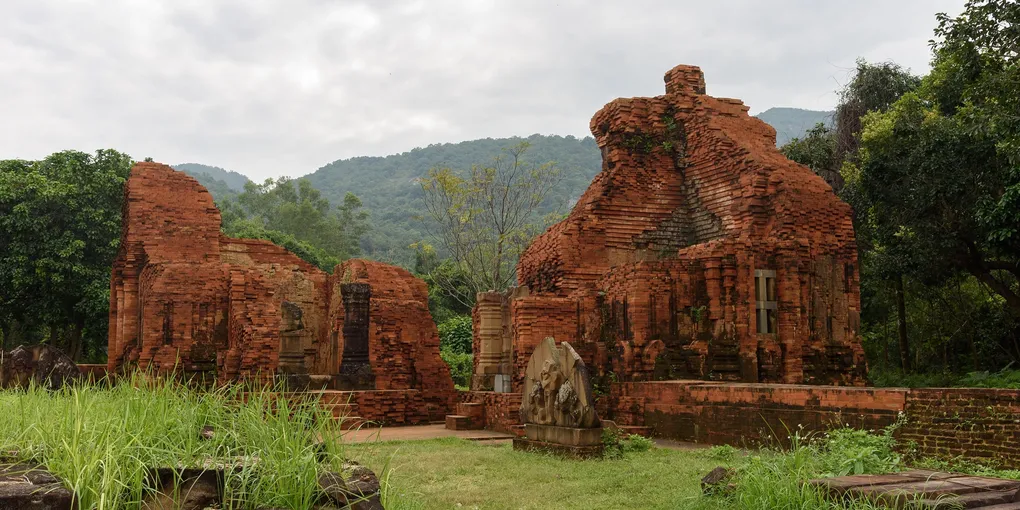
Around the year 400, a king of Champa installed a linga of the god Shiva in a quiet valley in the hills of central Việt Nam, and had a stone inscription cut to protect it. In the translation usually cited, the stele ends with a plea to whoever came after him: “Out of compassion for me do not destroy what I have given.” For about nine hundred years his successors more or less obeyed. They kept building on the same spot, in brick, until the valley held more than seventy temples. The hard part came later.
That valley is Mỹ Sơn, the “beautiful mountain”. It is the most important religious site of the Cham kingdoms that ruled the central coast of what is now Việt Nam for over a thousand years.
A closed valley for a god-king
Mỹ Sơn sits in a basin about two kilometres wide, ringed by mountains, on a tributary of the Thu Bồn river. It is roughly 70 km southwest of central Đà Nẵng. Until the 2025 provincial merger it lay in Quảng Nam province; it is now part of the enlarged city of Đà Nẵng. About ten kilometres away is Trà Kiệu, which many scholars identify with Simhapura, an early Cham capital. The arrangement is familiar from the wider Hindu world: a royal city on the plain, and a sacred mountain sanctuary a short journey inland.
Champa was not “Vietnamese” in the medieval sense. Its people spoke an Austronesian language, wrote in scripts derived from India, and worshipped Shiva and Vishnu, with Buddhism in some periods. Their ships traded along the maritime routes between India and China. Mỹ Sơn is the clearest physical evidence that Việt Nam’s history includes this second, Indianised civilisation, alongside the Red River kingdoms in the north.
Burnt, rebuilt, renamed
The king of the founding inscription was Bhadravarman I, usually dated to the late fourth and early fifth centuries. He named his god Bhadreśvara, joining his own name to īśvara, “lord”. The king and the god were deliberately tied together.
That first temple was largely wooden, and it did not last. An inscription records a great fire around 535–536. In the following century King Sambhuvarman (reigned c. 572–629) rebuilt it and re-installed the god as Sambhu-Bhadreśvara: again, the reigning king’s name joined to the god’s. Later rulers kept adding temples, gate-towers and halls through the seventh to thirteenth centuries. About thirty-two steles, dated from the fifth to the twelfth century, have been found on the site. They form one of the main written sources for Cham history.
A building trick nobody has fully explained
Almost every Mỹ Sơn temple is red brick; only one major building (B1) uses stone in quantity. The bricks fit so tightly that the joints are almost invisible, and the decoration (pilasters, arches, flying figures) was carved straight into the brickwork rather than onto added stone panels.
How the Cham did this is still partly an open question. Research during later restoration work points to bricks fired in wood kilns to a carefully moderate hardness, bonded with a natural resin; dầu rái (Dipterocarpus alatus) is the tree most often named. Whether the carving was done before or after the walls went up is still debated. Restorers working with modern materials have found it hard to match the original.
Letters on a map
French scholars reached the valley at the end of the nineteenth century; the explorer Camille Paris is usually credited with its rediscovery in 1898. The architect Henri Parmentier of the École française d’Extrême-Orient then surveyed it and recorded the remains of 71 structures. He sorted them into groups labelled with letters (A, A′, B, C, D, E, F, G, H, K and others) and numbered each building within its group. That is why guides today still talk about “tower A1” or “group G”. French conservators began repair work in 1937 and continued into the early 1940s.
A1 was the showpiece: a tall sanctuary tower that Parmentier’s generation considered the masterpiece of Cham architecture. It no longer exists.
One week in 1969
During the American war the valley’s natural shelter made it a base area for communist forces, and in August 1969 it was bombed heavily from the air. Within roughly a week much of the complex was destroyed, A1 included; little now remains of it except a heap of brick around its pedestal. The bomb craters are still visible, and unexploded ordnance kept parts of the surrounding hills dangerous for decades. Of Parmentier’s 71 structures, only a fraction still stand in recognisable form.
The people who kept the promise
Bhadravarman’s plea ended up being answered by foreigners as much as by Cham kings.
From 1981 a joint Polish–Vietnamese team led by the architect Kazimierz Kwiatkowski, known in Việt Nam as Kazik, cleared rubble and shored up the surviving towers at Mỹ Sơn. He worked at Hội An and Huế as well, and argued for protecting all three when the country had few resources for conservation. He died in Huế on 19 March 1997. A statue of him stands in a small park on Trần Phú street in Hội An.
UNESCO inscribed the Mỹ Sơn Sanctuary as a World Heritage Site in 1999, the same year as Hội An Ancient Town. An Italian–Vietnamese project with UNESCO restored group G between 2003 and 2013. From 2017 to 2022 the Archaeological Survey of India restored groups A, H and K, and in 2025 it began a second project on groups E and F, scheduled to run to 2029.
Some of Mỹ Sơn’s finest carving is no longer in the valley at all. The great sandstone altar from temple E1, carved with ascetics and musicians, is in the Museum of Cham Sculpture in Đà Nẵng and was recognised as a national treasure in 2012.
Why it matters
Mỹ Sơn is a reminder that “Vietnamese history” covers more than one people. The Cham built here for nine centuries before Đại Việt expanded south and Champa was gradually absorbed. Their descendants still live in Việt Nam today, mostly further south. The valley is also a record of how fragile such places are: centuries of care, a fire, a week of bombs, and then decades of slow, internationally funded repair, brick by brick, by people trying to honour a request made sixteen hundred years ago.
Sources
- My Son Sanctuary — UNESCO World Heritage Centre
- Mỹ Sơn Sanctuary — Wikipedia
- Mysteries of Mỹ Sơn Sanctuary unveiled through restoration — Việt Nam News
- Press release on completion of conservation and restoration of A, H and K temples at My Son Sanctuary — Embassy of India, Hà Nội
- Revival of last abandoned ancient towers in Mỹ Sơn — Việt Nam News
- Kazimierz Kwiatkowski (architect) — Wikipedia
- Việt Nam pays tribute to Polish architect Kazik — Việt Nam News
- 9 bảo vật quốc gia được lưu giữ tại Bảo tàng Điêu khắc Chăm Đà Nẵng — Sài Gòn Giải Phóng
Cover photo: Mỹ Sơn Cham temple ruins, by Mustang Joe, CC0, via Wikimedia Commons.
