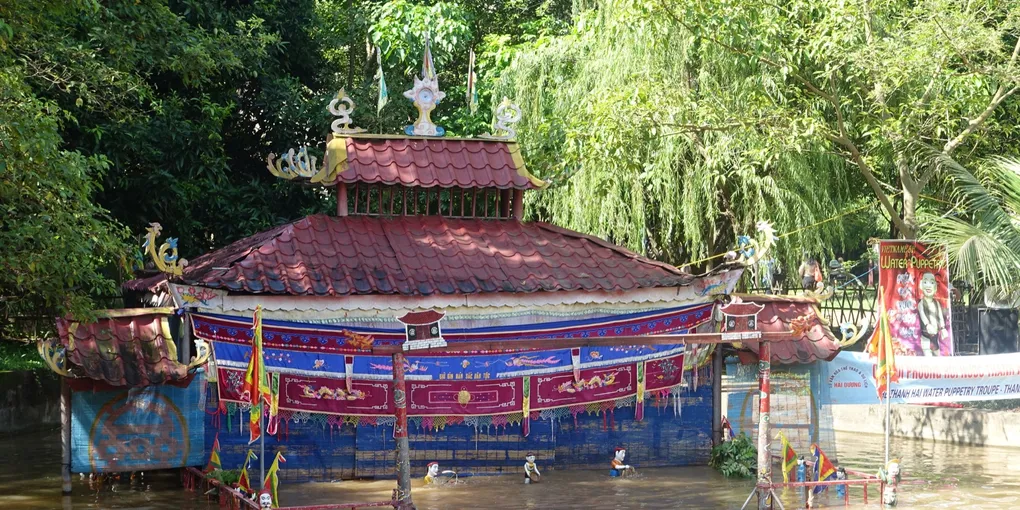
Most theatre asks you to imagine that the stage is somewhere else. Vietnamese water puppetry (múa rối nước) doesn’t bother: the stage is a pond, the actors are carved wood, and the farmers who invented it simply turned the landscape they worked in every day into a show. For visitors to Hà Nội, it’s often the first evening out. For people who grew up in the Red River Delta, it’s the sound of drums and firecrackers over a village pond at festival time.
A pond, a pavilion, and a bamboo screen
The set-up is simple to describe and hard to do. In the middle of a pond — traditionally one attached to the village temple or pagoda — stands a small pavilion called the thủy đình, the “water pavilion,” roofed like a miniature temple. Its front is hung with a bamboo screen. Behind it, in the buồng trò (the puppeteers’ booth), the performers stand waist-deep in water, hidden from the audience, working the puppets out through the screen and across the water.
The puppets themselves are carved from light wood — traditionally sung (fig wood), though some guilds use other light, rot-resistant timbers — and finished in lacquer so they survive years of soaking. Most stand around 30–40 cm; the larger figures can be heavy enough that one person struggles to handle them.
They move by two kinds of mechanism, both hidden below the waterline. The máy sào is a rigid pole, several metres long, with the puppet mounted on its end and levers or strings running along it to work arms and heads. The máy dây is a system of cords stretched underwater around stakes, so a puppet can glide from one side of the pond to the other with no visible means of support. The murky water is not a flaw; it’s the whole trick. It hides everything.
Nine hundred years of evidence
Water puppetry is usually described as having roots in the delta’s farming villages, played in flooded fields and ponds between harvests. The earliest written evidence is precise: a stone stele at Long Đọi pagoda (Đọi Sơn, in today’s Hà Nam area), the Sùng Thiện Diên Linh stele dated 1121, describes a water show staged for the birthday of King Lý Nhân Tông — golden turtles rising from the waves carrying three mountains on their backs, and fairy figures dancing on the water. By then it was already court-level spectacle, which suggests the folk form behind it was older still.
For the next several centuries it lived mostly in the villages, run by phường rối — puppetry guilds tied to specific communes. In the north the famous names include Đào Thục (Đông Anh, on Hà Nội’s outskirts), whose guild traces its craft to a founder who served at the court of King Lê Ý Tông in the 18th century and brought it home to teach, and the villages of Thái Bình, where Nguyên Xá and Đông Các are often called the cradle of the art. Both troupes were given national intangible cultural heritage status — the Thái Bình tradition in 2018, Đào Thục in 2023.
The secrets, and who wasn’t allowed to know them
Each guild guarded its mechanisms jealously: how a dragon is made to spit water, how a fish leaps, how a puppet appears to walk on the surface. Villagers today still tell of oaths sworn at the guild’s founding shrine, and the old rule was that the craft passed to sons and to daughters-in-law, but not to daughters — because a daughter would marry into another village and take the secrets with her. The detail is worth pausing on. It says something about how a village thought of knowledge: not as something you owned, but as something the community held, and the family line carried.
Uncle Tễu and the repertoire
Every show opens with chú Tễu — Uncle Tễu — a chubby, bare-chested boy-man in a loincloth with a tuft of hair and a permanent grin. He is the host, the narrator, and the licensed fool: in village performances he was free to poke fun at greedy officials and pompous notables in a way no living person on stage could have got away with. Each guild has its own Tễu, and the carvings from Thái Bình and Đào Thục are among the most admired.
After Tễu, the repertoire is village life raised to the level of myth. There are scenes of ploughing and rice planting, catching frogs and fishing, buffalo fights and wrestling, boat races; there are dragons, phoenixes and unicorns dancing through spurts of water and fire; and there are the stories everyone knows — Thạch Sanh, Tấm Cám, and the legend of Lê Lợi returning the sacred sword to the golden turtle of Hoàn Kiếm Lake (a legend, of course, not a historical record). A small orchestra plays alongside — drums, gongs, cymbals, bamboo flute and the one-stringed đàn bầu — and singers in the style of chèo, the north’s popular folk opera, give the puppets their voices.
From the village pond to the city stage
The form that most visitors see today took shape in the 20th century. The Thăng Long Water Puppet Theatre began in 1969 as a small troupe; in the 1980s its artists studied water puppetry directly with village masters, and it has played to international audiences for decades, settling by Hoàn Kiếm Lake in the 1990s. City shows are tighter and more polished; the village performances, where they still happen, are rougher and more alive — outdoors, at festival time, with the audience on the pond bank and children trying to work out where the puppeteers are.
If you can, see both. Watch the city show for the craft. Then find a village festival, or the outdoor thủy đình at the Museum of Ethnology in Hà Nội, and watch the art in the setting it was made for: water, open sky, and a drum telling the village that the show is about to start.
Sources
- Sùng Thiện Diên Linh stele and the history of water puppetry — Vietnam National Puppetry Theatre
- Water puppetry — Wikipedia
- Nghệ thuật múa rối nước (Thái Bình) — Cục Di sản văn hóa
- Múa rối nước Đào Thục — Sở Văn hóa và Thể thao Hà Nội
- Múa rối nước — Wikipedia tiếng Việt
Cover photo: the Thanh Hải water puppetry troupe performing at the Vietnam Museum of Ethnology, Hà Nội, by Daderot, CC0 (public domain), via Wikimedia Commons.
