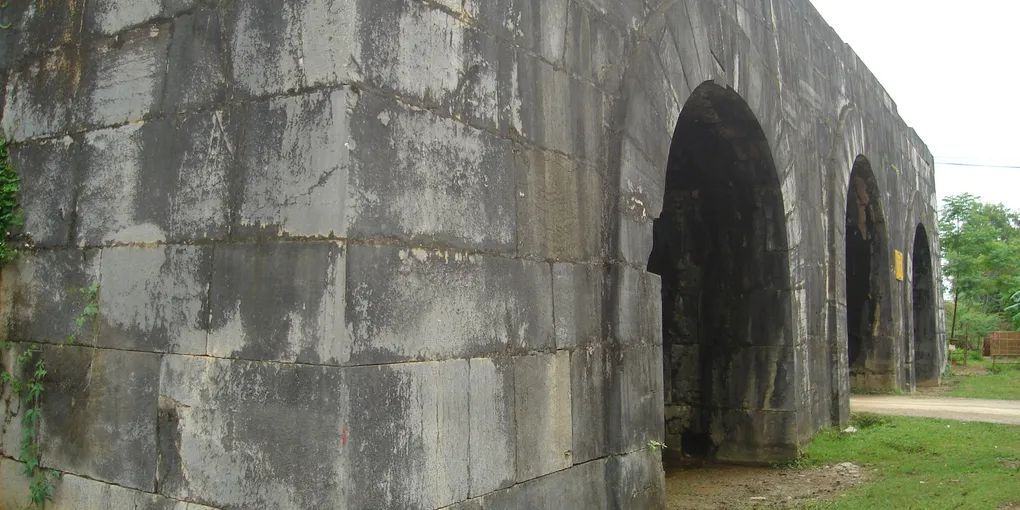
In the rice country of Thanh Hóa, about 150 km south of Hà Nội, a stone gate stands in the middle of the fields. It has three arched openings, and its walls are made of limestone blocks so large that each one looks like a piece of furniture: on average about 2 metres long, 1 metre high and 0.7 metres thick, many weighing well over ten tonnes. There is no mortar between them. They have held together for more than 600 years.
This is the Citadel of the Hồ Dynasty (Thành nhà Hồ), once called Tây Đô, the Western Capital. It is one of the most impressive pieces of medieval engineering in Southeast Asia. It is also a monument to a regime that lasted only seven years, and the gap between those two facts is the story.
A minister who wanted a new capital
At the end of the 14th century the Trần dynasty, which had beaten back the Mongols a century earlier, was exhausted. Real power had passed to a senior minister and royal in-law, Hồ Quý Ly (born Lê Quý Ly, 1336). He was a reformer with a sharp mind and few scruples, and he wanted the court out of Thăng Long, where the Trần aristocracy had its roots.
In the first month of 1397, according to the Vietnamese chronicles, he sent the official Đỗ Tỉnh to survey a site at An Tôn in Thanh Hóa, the Hồ family’s home region. Walls were raised, moats dug, an ancestral temple and altars built. The chronicles say the stone citadel went up in roughly three months. The new capital was named Tây Đô; Thăng Long became Đông Đô, the Eastern Capital. The Trần court was moved south, and the dynasty’s days were numbered.
In 1400 Hồ Quý Ly deposed the last Trần ruler, took the throne himself and renamed the country Đại Ngu. A year later he handed the title of emperor to his son Hồ Hán Thương while keeping control as retired emperor.
How the walls were built
The inner citadel is close to a square, about 870 by 883 metres, with a gate in each side. The walls are not solid stone. Excavations of the northeast wall in 2019 showed a core of packed earth faced with dressed limestone blocks, cut so precisely that they lock together by weight alone. Most of the wall is 5–6 metres high and rises to around 10 metres at the gates.
The gates are the masterpieces. Their arches are built from wedge-shaped stone blocks, a technique that let builders span large openings without timber. The South Gate, the main entrance, has three openings, the central one about 8 metres high. Beyond the stone walls lay an outer earthen rampart, the La Thành, and in 1402 Hồ Hán Thương had a Nam Giao altar for the sacrifice to Heaven built at the foot of Đốn Sơn hill, about 2.5 km to the southeast. Excavations there have uncovered its terraces and a stone-lined well.
When UNESCO inscribed the site as a World Heritage property in 2011, it singled out exactly this: the use of huge stone blocks as evidence of the organising power of a Neo-Confucian state in late 14th-century Việt Nam, and a new style of imperial city in East and Southeast Asia.
The reformer’s gamble
The citadel was one part of a larger, unusually radical programme. The Hồ issued Việt Nam’s first paper money (the Thông bảo hội sao, 1396). They set legal limits on the land (hạn điền, 1397) and the number of bonded servants (hạn nô, 1401) a person could hold, a direct hit at the wealth of the old Trần nobility. Hồ Quý Ly also promoted writing in chữ Nôm and reformed the examinations.
Historians still argue about whether he was a visionary or a usurper. Both can be true. What is clear is that his reforms made powerful enemies at home just as a powerful enemy abroad was looking for a pretext.
Weeks, not years
In late 1406 the armies of the Ming Yongle Emperor crossed the border, claiming to restore the Trần. The Hồ had prepared: fortified lines along the main rivers, firearms. It was not enough. By late January 1407 both capitals had fallen, Tây Đô among them. The great stone walls did not hold up the invasion for long. By June the Hồ family had been captured. Hồ Quý Ly and Hồ Hán Thương were taken to China and died in exile. Đại Ngu became the Ming province of Jiaozhi for twenty years, until Lê Lợi’s uprising drove the Ming out.
The chronicles attribute one line to Hồ Quý Ly’s eldest son, Hồ Nguyên Trừng, spoken when the court debated how to meet the threat: “I am not afraid to fight; I am only afraid the people’s hearts will not follow.” Whatever its exact wording, it is the best explanation of the citadel’s fate. Stone could be quarried in months. Loyalty could not.
Nguyên Trừng’s own story has a strange coda. Captured and taken north, he was put to work making firearms for the Ming, rose to high office in the Ming Ministry of Works, and in old age wrote a memoir of his homeland, the Nam Ông mộng lục.
Why it still matters
Today the citadel sits in what used to be Vĩnh Lộc district, with rice paddies inside its walls and cattle grazing by the gates. Most of the wall circuit is ruined, but the four gates survive, and archaeologists are still working out where the palaces stood.
It is worth the detour not only for the stonework. Tây Đô is a rare place where you can stand inside a historical argument: about how fast a state can be rebuilt from the top, and how much of a nation’s strength sits in its walls and how much in its people. Hồ Quý Ly built the strongest walls of his age. He still lost the country in a season.
Sources
- Citadel of the Ho Dynasty — UNESCO World Heritage Centre
- Citadel of the Hồ Dynasty — Wikipedia
- Hồ Quý Ly — Wikipedia
- Ming conquest of Đại Ngu — Wikipedia
- Hồ Nguyên Trừng — Wikipedia
- Thanh Hoá uncovers its past — VietNamNet
- Central province approves excavation of citadel — Việt Nam News
- Ancient worship ceremony held after 600-year break — Việt Nam News
- Huyền bí thành nhà Hồ — Giáo dục Việt Nam
- The state and law under the Hồ dynasty (1400–1407) — Vietnam Law & Legal Forum
Cover photo: South gate of Tây Đô castle by Silviculture, public domain, via Wikimedia Commons.
