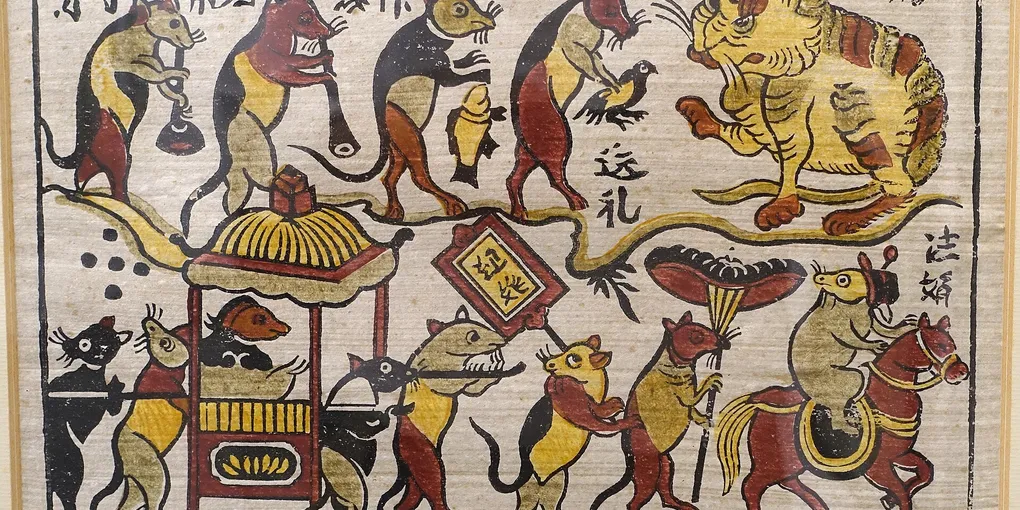
Walk into an old northern Vietnamese house in the days before Tết, a century ago, and among the peach branches and the new ancestral offerings you would likely have found a few sheets of cheap, cheerful paper pinned to the wall: a fat sow with her piglets, a hen surrounded by chicks, a procession of rats carrying a bride. They came from one village on the Đuống River, and they were meant to last exactly one year. Next Tết you bought new ones.
That village is Đông Hồ, in Thuận Thành, Bắc Ninh — about 35 km east of Hà Nội. Its prints, tranh Đông Hồ, are the best-known folk art in Vietnam, the kind of image a Vietnamese child recognises long before they know where it comes from. In December 2025 UNESCO added the craft to its List of Intangible Cultural Heritage in Need of Urgent Safeguarding — the word that matters there is urgent.
Paper that sparkles
The base of a Đông Hồ print is giấy dó, the tough, fibrous paper made from the bark of the dó tree. On its own it is a soft cream. The Đông Hồ printers coat it with điệp — seashell powder, ground fine and mixed with a sticky rice paste — brushed on in long strokes. Dry, it gives the sheet a faint pearly shimmer and a ribbed texture you can see in raking light (look closely at the photo above). The paper has its own name, giấy điệp, and it is the first thing that separates a real print from a photocopy.
Colours from the landscape
The palette is short and entirely natural, and every colour comes from something you could find in the delta:
- red from sỏi son, a red gravel ground to powder;
- yellow from the buds of the hoè tree (Sophora);
- blue-green from indigo leaves;
- white from the shell powder itself;
- black from the charcoal of burnt bamboo leaves or glutinous-rice straw.
That restraint is the look. Colours sit flat and slightly uneven, the grain of the block shows through, and the shell coating catches the light behind them.
One block per colour, black last
Each design is carved into several woodblocks — traditionally of thị wood (a persimmon relative) — one for every colour plus one for the outline. The printer brushes pigment onto a block, lays the paper down and presses it by hand, then moves to the next colour, lining the sheet up by eye. Colours go on first, starting with red; the black line block is printed last, pulling the whole image together. A single print can pass through four or five pressings, which is why a good printer’s registration — every colour landing where it should — is a mark of skill.
What the pictures say
Researchers sort the repertoire into seven families: devotional images, auspicious wishes, history, stories, proverbs, landscapes, and scenes of daily life. The famous ones are mostly wishes. Lợn đàn, a sow with piglets, often marked with a swirl many read as the yin-yang sign, and Gà đàn, the hen and chicks, are prayers for plenty and many children. Children hugging a rooster or a duck say vinh hoa and phú quý — honour and wealth. Bà Triệu riding her elephant and the Trưng sisters carry the history.
Then there are the jokes. Đám cưới chuột, “The Rats’ Wedding” (the cover image), shows a rat groom on horseback and a bride in a palanquin — but first the procession has to pass the cat, so the rats arrive bearing a fish and a bird as gifts. The usual reading is a sly dig at petty officials who had to be paid off before anything could happen in a village; nobody signed it, so nobody could be blamed. Đánh ghen, a wife confronting her husband’s other woman, is just as frank. These were peasants’ pictures, and they laughed at what peasants laughed at.
Five market days in the last month
For most of its history the village worked all year for a single season. The old Tết print market was held at the Đông Hồ communal house on five days of the twelfth lunar month — the 6th, 11th, 16th, 21st and 26th — and traders bought them by the stack to carry to markets across the north. The market faded out around 1945, in the years of war, and with it the rhythm that had sustained the village. In 1948 the poet Hoàng Cầm, writing from the other bank of the river, mourned it in Bên kia sông Đuống, with the lines every Vietnamese schoolchild learns about “Đông Hồ pigs and chickens, fresh clean lines / the nation’s colours shining on seashell paper”.
A handful of families
Seventeen lineages once made prints in Đông Hồ. Today the craft is kept by two or three families, chiefly the Nguyễn Đăng and Nguyễn Hữu lines, with around thirty people across several generations. Much of the revival is owed to the artisan Nguyễn Đăng Chế, who collected and restored old blocks — some more than two centuries old — and opened a centre for the craft in 2008; the late master Nguyễn Hữu Sam passed his blocks to his son. The pressure is easy to see: Tết decoration moved to plastic and printed posters, and cheap imitations on ordinary paper undercut the real thing. Bắc Ninh now has a safeguarding programme running to 2035, and the old market was staged again in 2024.
If you go, buy a real one — check for the shimmer of the điệp and the slight ridges in the colour — and hang it for Tết, which is what it was made for.
Sources
- Đông Hồ folk painting craft added to UNESCO’s urgent safeguarding list — Việt Nam News
- Nghề làm tranh dân gian Đông Hồ được UNESCO ghi danh — Báo Chính phủ
- Tranh dân gian Đông Hồ — Cục Di sản văn hóa
- Bắc Ninh tái hiện chợ tranh Đông Hồ xưa — VNA
- Đông Hồ painting — Wikipedia
Cover photo: The Rats’ Wedding (Đám cưới chuột), Đông Hồ print in the Vietnam National Museum of Fine Arts, Hà Nội, by Daderot, CC0 (public domain), via Wikimedia Commons.
