In 1980, Makoto Anabuki, a Japanese diplomat posted to Hà Nội, was travelling in Turkey and stopped in front of a blue-and-white vase in the Topkapı Palace Museum in Istanbul. It stood 54 centimetres tall, and the museum’s label called it Chinese. Anabuki read classical Chinese, and the thirteen characters around the vase’s shoulder told him something else. They dated the piece to the eighth year of the Thái Hòa reign, which is 1450, under the Lê emperor Lê Nhân Tông, and they named where it came from: Nam Sách châu, a district in the Red River Delta east of Hà Nội. The vase was Vietnamese, and it was signed.
Back in Việt Nam, Anabuki wrote a letter to Ngô Duy Đông, Party secretary of Hải Hưng province (today’s Hải Dương and Hưng Yên), asking where in Nam Sách such a vase could have been made and whether he could be put in touch with local archaeologists. Nobody could answer him. The letter went down the chain to the provincial museum and landed with an archaeologist named Tăng Bá Hoành, who would spend the next three decades trying to.
Kilns under the rice fields
Nam Sách in 1980 had no potters. Chu Đậu, a village in Thái Tân commune beside the Thái Bình River, grew rice and had no memory of ever having done anything else. Yet when Hoành’s team surveyed it in 1983 they found sherds and kiln debris in the fields, and excavations from 1986 to 1991 — eight seasons in all, by the provincial museum’s count — uncovered more than a hundred kiln bases, along with kiln spacers and heaps of misfired rejects. The blue-and-white fragments matched the vase in Istanbul.
The finds dated the village’s output from roughly the fourteenth century, through a peak in the fifteenth and sixteenth, to an abrupt end in the seventeenth. For two hundred years this quiet place had been one of the largest ceramics centres in Southeast Asia, and then it had forgotten entirely. (Administratively, Chu Đậu has kept moving without going anywhere: Hải Hưng was split back into Hải Dương and Hưng Yên in 1997, and in the 2025 provincial mergers Hải Dương was folded into Hải Phòng city.)
Why the fifteenth century
Chu Đậu’s rise had as much to do with China as with Việt Nam. For much of the fifteenth century the Ming court restricted private overseas trade, and Chinese export porcelain all but vanished from the markets of Southeast Asia — archaeologists call the resulting hole in shipwreck cargoes the “Ming gap.” Kilns in Việt Nam and Thailand stepped into it. Vietnamese blue-and-white of this period has been excavated from Japan, where it was prized in the tea ceremony and called An Nam ware, to Java, the Philippines, the Gulf port of Julfar, Egypt and Turkey. At Trowulan, the capital of the Majapahit empire in Java, the great majority of imported Southeast Asian ceramics in the fifteenth century were Vietnamese. The vase in Topkapı is simply the most famous member of a very large diaspora.
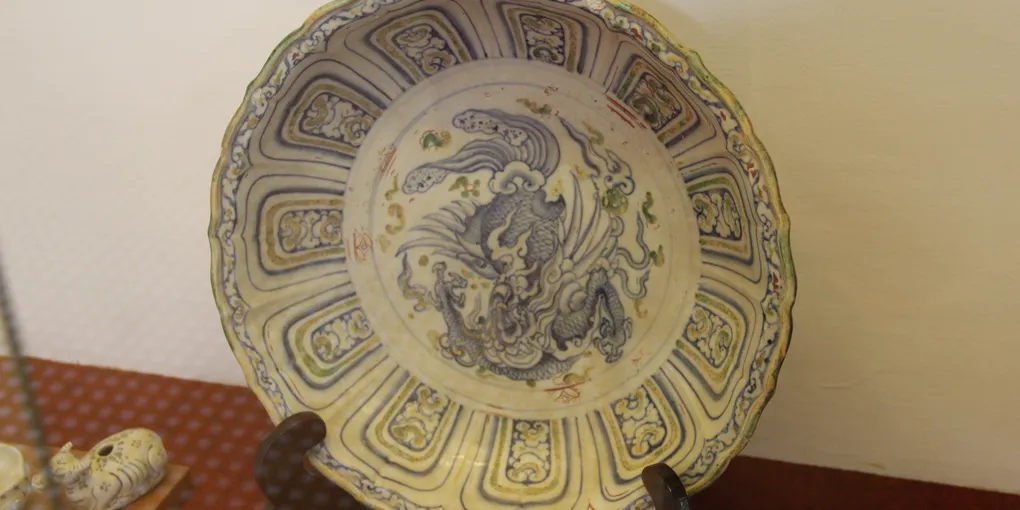
Hải Dương was well placed for the trade: good clay, and the Thái Bình river system running past the village door down to the sea. What the kilns made was not courtly porcelain but confident, quickly painted stoneware: bowls, dishes, jarlets, covered boxes and ewers, painted in cobalt under a clear glaze, sometimes finished with red and green enamels and gilding on top. Chrysanthemums, lotus scrolls, fish, birds, dragons and phoenixes, drawn by hands that had clearly drawn them thousands of times before.
A ship that never arrived
The best evidence of that trade lay at the bottom of the sea. In the early 1990s fishermen working off the Cù Lao Chàm islands near Hội An began hauling up intact bowls and dishes in their nets, and dealers followed. After two Japanese traders were arrested trying to smuggle pieces out of the country, the government licensed a proper excavation: a Malaysian businessman, Ong Soo Hin, and his salvage company Saga Horizon, working with the state salvage agency VISAL and the National Museum of Vietnamese History, under the Oxford marine archaeologist Mensun Bound. The wreck lay about 70 metres down and some 40 kilometres offshore, beyond ordinary diving depth, and the team worked it over three seasons in the late 1990s.
What came up was a quarter of a million intact pieces of mid-to-late-fifteenth-century Vietnamese ceramics, the overwhelming majority blue-and-white in the Chu Đậu style. Việt Nam kept every unique piece and a share of the rest; the remainder went to Butterfields in San Francisco in October 2000, in one of the largest ceramics auctions ever held. It was not a success: barely 40 percent of the lots sold, and by one account Ong had spent close to 14 million dollars to recover about 3 million. Museums did better out of it than investors. The National Museum of History in Hà Nội, the Museum of Trade Ceramics in Hội An, the British Museum and the Freer Gallery in Washington all hold pieces from what the trade calls the Hội An hoard.
The signature nobody agrees on
Which leaves the thirteen characters that started it all. In Hán-Việt reading they run: Thái Hòa bát niên, Nam Sách châu, tượng nhân Bùi thị hý bút. The first eight are not in dispute: “Thái Hòa year eight, Nam Sách district.” The last five are.
Tăng Bá Hoành reads them as “the artisan Bùi Thị Hý painted this”: a woman’s name, with Thị as the middle name Vietnamese women carry, which would make her the earliest Vietnamese artisan of either sex to sign and date a piece of work. He later published a Bùi family genealogy from a village in Gia Lộc district that describes a Bùi Thị Hý born in 1420, married into a family of kiln owners, trading with China, Japan and “the West.” In this version she is the founding mother of Chu Đậu, and she has since acquired statues, a posthumous award and a growing legend.
Many other scholars, including Nguyễn Đình Chiến of the National Museum of History, read the same characters differently. Thị can mark a family rather than a woman, and hý bút — “playful brush” — is a stock phrase a painter used to sign a piece done for amusement. On that reading the line means “an artisan of the Bùi family painted this for fun,” and the woman potter disappears. The genealogy and the inscribed objects that surfaced to support her have also been questioned in the academic press. The honest summary is that the date and the place are certain, the identity of the potter is not, and the argument is now older than the excavations.
Why it still matters
Chu Đậu died in war. Hải Dương was the home ground of the Mạc dynasty, and the long struggle between the Mạc and the Lê-Trịnh armies in the sixteenth century ran straight through it; local tradition, preserved in that same Bùi genealogy, says Trịnh Tùng’s forces laid waste to Nam Sách in 1593. The kilns were cold by the seventeenth century, Chinese porcelain was back in the sea lanes, and the potters’ descendants grew rice for three hundred years.
In 2001 the Hà Nội trading corporation Hapro built a new ceramics works in the village; the first containers left for Spain in 2003, and “Chu Đậu” is a national brand again, if a reinvented one. The old pieces, meanwhile, sit in museum cases in Hà Nội, Hội An, Hồ Chí Minh City, Tokyo, Istanbul and New York. It is a strange fact about a country’s past that so much of it can be stored abroad and underwater — and that Việt Nam learned the name of one of its great export industries from a letter a foreigner wrote after reading a museum label he did not believe.
Sources
- Chu Dau: Vietnam’s first exported ceramic brand — Nhân Dân
- Người làm chiếc bình gốm hoa lam cổ Chu Đậu — Nhân Dân
- Bí ẩn hành trình tìm lại gốm Chu Đậu — Báo Pháp luật Việt Nam
- Finding a ceramic kingdom under Lady’s reign — Việt Nam News
- The Topkapı vase and the “Bùi” signature — Southeast Asian Archaeology
- Hội An wreck — Wikipedia
- Hoi An Shipwreck — Trafficking Culture encyclopedia
- Vietnamese ceramics — Wikipedia
- Revival of age-old Chu Dau ceramics in Hai Duong province — Vietnam Law & Legal Forum
- Huyện Nam Sách tỉnh Hải Dương đổi thành gì sau sáp nhập 2025? — Thư viện Pháp luật
Cover photo: a 15th–16th-century Chu Đậu dish in the Museum of Vietnamese History, Hồ Chí Minh City, by Gary Todd, CC0, via Wikimedia Commons.
