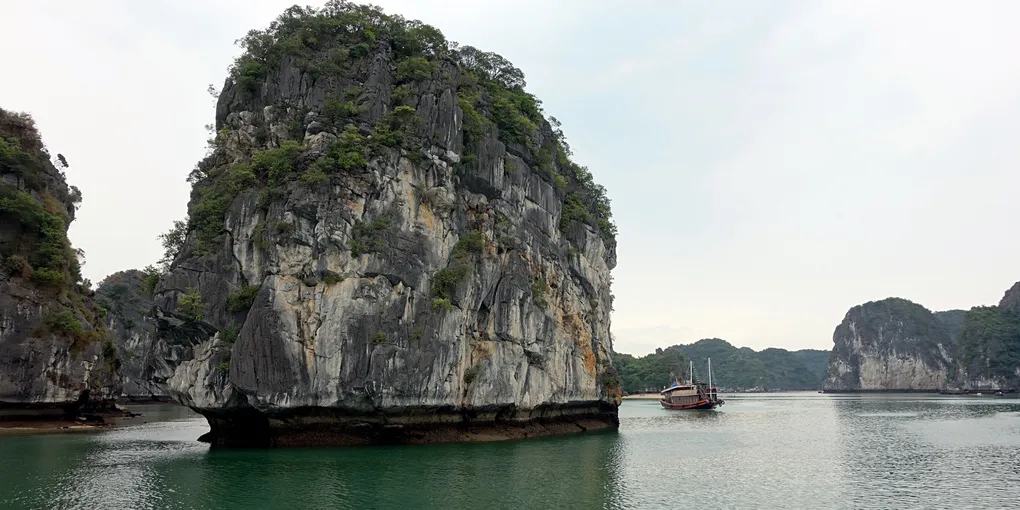
The usual pitch for Lan Hạ Bay is that it is “the quieter Hạ Long”. That is half true and slightly misleading. The towers of limestone rising out of green water are the same rock, shaped by the same processes; in September 2023 UNESCO made the point official by extending the Hạ Long Bay World Heritage site to cover the Cát Bà archipelago, renaming it Hạ Long Bay – Cát Bà Archipelago. So you are not choosing between a famous bay and a lesser one. You are choosing between two ways of seeing one landscape.
Hạ Long is mostly seen from the deck of a cruise boat that leaves from a mainland city and comes back to it. Cát Bà gives you something different: a real island to sleep on, with a town, a national park and a coastline, and a bay that starts a short boat ride from your guesthouse. That, rather than the crowds, is the organising idea for a visit. Come for the base, not just the view.
The island
Cát Bà is the largest island in the archipelago, and most of it is not bay at all but steep forested hills. Cát Bà National Park, established in 1986, covers a large share of the island, and the wider archipelago has been a UNESCO biosphere reserve since 2004. Its flagship resident is the Cát Bà langur, a golden-headed primate found nowhere else on Earth. It came close to disappearing: counts put the population at around 40–47 animals in 2000 and roughly 76–82 by 2023, depending on whose survey you read. Don’t expect to see one; the point is that they are still here at all.
One honest note: Typhoon Yagi hit the island hard in September 2024. Hotels and roads were back within weeks, but the forest is another matter — park authorities estimated three to five years or more for it to recover fully, so some trails look battered.
Closer to town, two short visits add history to the scenery. Hospital Cave (Hang Quân Y), about 10 km from town on the road towards the park, served as a bomb-proof hospital and shelter during the American war. Cannon Fort, on the hill above town, is a former gun emplacement whose real attraction is the panorama over the town, the bay and the islands beyond.
The bay
Lan Hạ lies off the island’s southeast — a few hundred limestone islets, small sandy coves and lagoons, most of them reachable only by water. The standard day trip from Cát Bà town is a boat with a kayaking stop and a swim, usually four to five hours; overnight cruises do the same at a slower pace. The best part is the kayaking: slipping under a rock arch into an enclosed lagoon with nothing but cliffs around you is the moment Lan Hạ is known for, and it is much easier to get here than on most Hạ Long itineraries.
You will also pass Cái Bèo, a floating fishing village beside one of the oldest archaeological sites in the region, first excavated by the French archaeologist Madeleine Colani in 1938. Its floating houses and fish farms are a living community, not a museum. Keep that in mind and keep your camera polite.
Honest downsides
Cát Bà town is not pretty. It is a dense strip of hotels and karaoke along the harbour, and at the time of writing, the waterfront is fenced off for construction expected to run into 2027. In summer, especially on weekends and holidays, the island fills with visitors from Hà Nội and Hải Phòng and the ferries queue. “Quieter” is relative: the popular lagoons now see a steady flow of boats in high season, and the floating farms mean the water near the villages isn’t always clean. Pick a tour that goes further out, and set off early.
Practical notes
- Getting there: the easiest option is a through bus-and-ferry ticket from Hà Nội (Old Quarter pick-up or Mỹ Đình): about two hours to Gót pier near Hải Phòng, a short car-ferry crossing, then roughly 30 minutes by road to town — 4 to 5.5 hours in total, typically 230,000–350,000đ. The alternative is the public ferry from Tuần Châu (Hạ Long) to Gia Luận at the island’s north, about an hour through the karst; it makes a fine scenic link if you are combining both bays. Check current schedules, as operators and pier names change.
- How long: two nights is the minimum; three lets you give one day to the bay and one to the island.
- When: spring (March–May) and autumn (September–November) are the sweet spots; May–July has the calmest sea for kayaking but peak domestic crowds. Winter is grey, cool and quiet, and storms can cancel ferries — watch typhoon forecasts in late summer and autumn.
- Costs (as a guide only): Lan Hạ day tours with kayaking run roughly 450,000–650,000đ per person, depending on the operator and route.
- Eat: seafood — squid, clams and fresh fish bought by weight. Agree on the price per kilo before it goes into the pan. Stop in Hải Phòng on the way for a bowl of bánh đa cua, the city’s red crab noodle soup.
- Stay away from the main harbour strip if you can, in Cái Bèo or a quieter stretch of the island — you came here for the bay, not the karaoke.
Cover photo: Lan Hạ Bay by Velvet, CC BY-SA 4.0, via Wikimedia Commons.
