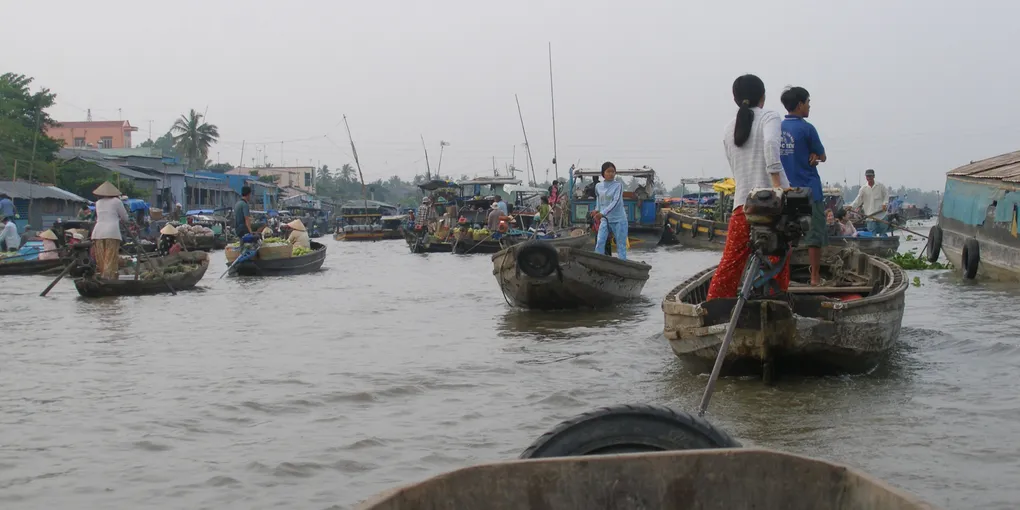
Most people come to Cần Thơ for one photograph: dawn on the river at Cái Răng, wooden boats loaded with pineapples and pumpkins and watermelons, each one advertising its cargo by hanging a sample from a tall bamboo pole called a cây bẹo. That photograph is still possible. But the honest way to see the Mekong delta’s biggest city is to understand that the floating market is a fading thing, and that the reason it is fading tells you more about the delta than the market itself.
A market built on water, undone by roads
For generations, the river was the road. Orchards and rice paddies in the delta were reached by canal, so produce moved by boat, and wholesalers met where the waterways converged. Cái Răng, a few kilometres downstream from the city centre on the Cần Thơ river, became the biggest of these meeting points. In 2016 the Ministry of Culture listed it as national intangible cultural heritage.
Then the roads arrived. Rural roads and bridges now let traders drive a truck straight to the orchard and sell to warehouses on land. Vietnamese press coverage of the market puts today’s numbers at around two hundred trading boats, several hundred fewer than twenty years ago. Phong Điền, the smaller “neighbourhood” market upstream that guidebooks long recommended as the authentic alternative, has, by local reports, all but stopped meeting.
None of this is a reason to skip Cái Răng. It’s a reason to treat it as a working market in transition rather than a museum: some of the boats you see are wholesalers, some sell coffee and noodles to the wholesalers, and some, frankly, are there for you.
How to do Cái Răng properly
Go early. The market is at its busiest roughly from 5 to 8 a.m. and noticeably quieter by nine, so book a boat from Ninh Kiều wharf in the city and leave before sunrise. The ride down is about half an hour. Smaller boats are better than the big tour launches: you can pull up alongside a seller, and a bowl of hủ tiếu handed across from a floating kitchen is the best breakfast in the city.
Most half-day tours then turn into the side canals, to a rice-noodle workshop or a fruit orchard. It is touristy, but this is where you see the second idea of the delta: houses facing the water rather than the road, children paddling to school, a whole life organised around the tide.
The rest of Cần Thơ
Give the city at least one more day. The Bình Thủy ancient house, built from 1870 by the Dương family, is a lovely oddity: French colonial façade, a traditional Vietnamese ancestral hall inside, and tiled floors you could stare at for an hour. Cồn Sơn, an island in the Hậu river reached by a short ferry, runs a community tourism scheme in which families host visitors in their orchards and fish ponds. It’s well done and the money goes to the islanders. In the evening, walk the Ninh Kiều riverfront and the night market, then eat: bánh xèo the size of a dinner plate, lẩu mắm (fermented-fish hotpot, with a tangle of wild greens), and whatever fruit is in season.
One administrative note: since July 2025, Cần Thơ has absorbed the former provinces of Hậu Giang and Sóc Trăng, so some addresses and signage may not match older guides.
Practical notes
- Getting there: about 170–180 km from Hồ Chí Minh City. With the expressways now running most of the way, buses and limousine vans take roughly three to four hours from the city. Cần Thơ also has an airport with direct flights from Hà Nội and other cities.
- How long: two nights is right. Arrive in the afternoon, do the market on the first morning, and spend the second day on Bình Thủy, Cồn Sơn and eating.
- When to go: December to April is dry and pleasant. The flood season (mùa nước nổi), roughly August to November, is the most atmospheric time: high water, fresh-water fish, and bông điên điển (sesbania flowers) on every menu. Mid-year, from about May to August, is fruit season.
- Where to stay: near Ninh Kiều, so you can walk to the boats before dawn.
- Downsides: the market can feel staged by late morning; some boat touts quote inflated prices, so agree the route, duration and price before you board; and the early-afternoon heat is real.
Cover photo: boats at the Cần Thơ floating market by Vyacheslav Argenberg, CC BY 4.0, via Wikimedia Commons.
