On Monday mornings at many Vietnamese high schools, a certain sight repeats itself: rows of teenage girls cycling to school in white áo dài, the front and back panels lifting in the wind, one hand on the handlebar and the other pinning the hem away from the spokes. It looks timeless. It isn’t. The garment most visitors photograph — close-fitting, slit to the waist, worn over loose trousers — is less than a century old in its current shape, and its ancestors were shaped as much by politics as by taste.
A dress code from the south
The story usually starts in 1744, in Phú Xuân (today’s Huế). Vietnam was then split between two rival houses: the Trịnh lords ruling the north from Thăng Long, and the Nguyễn lords governing the expanding south, Đàng Trong. According to accounts going back to the scholar Lê Quý Đôn’s Phủ biên tạp lục, Lord Nguyễn Phúc Khoát — who that year styled himself a king — ordered his court, men and women alike, to wear trousers under a gown buttoned down the front. In the north, court ladies still wore the crossed-collar áo giao lĩnh with a long skirt.
Clothes, in other words, were a statement of sovereignty: we are a separate realm, and you can see it on our bodies. The gown that came out of this reform is usually identified with the áo ngũ thân, the “five-panel” tunic — two panels sewn together at the back, two at the front, and a small fifth panel hidden under the front flap. Folk explanations say the five panels stand for the parents and the self, or for the five Confucian virtues; that symbolism is tradition, not something the decree spelled out.
When the Nguyễn finally unified the country in 1802, the southern style travelled north. Under Emperor Minh Mạng (r. 1820–1841), the court pushed to standardise dress across the realm, and historians of Huế credit him with turning the trousered gown into something close to a national costume. Northern villagers were not thrilled. A well-known folk couplet — “Tháng tám có chiếu vua ra / Cấm quần không đáy người ta hãi hùng” (“In the eighth month the king’s edict came / banning bottomless trousers — people were aghast”) — pokes fun at officials trying to get women out of their wraparound skirts. Whether it records one specific edict is debated; as a mood, it is perfect.
Hà Nội, 1930s: the art-school makeover
The five-panel gown was still roomy and boxy. The tight silhouette we know today came from Hà Nội in the 1930s, from painters rather than tailors.
Nguyễn Cát Tường, a graduate of the Indochina College of Fine Arts who signed his designs “Le Mur” (a French play on tường, “wall”), began showing a reworked gown in the pages of Phong Hóa and later Ngày Nay — the magazines of the reformist Tự Lực văn đoàn literary group. His áo dài hugged the body, used lighter fabric and borrowed Parisian touches: puffed shoulders, lace collars, scalloped hems. Critics called it lai căng — mongrel, too Western. Young urban women wore it anyway.
Within a few years another painter, Lê Phổ, toned the design down, stripping out the most European flourishes and bringing back details from older Vietnamese dress. Different sources give slightly different dates and credits for each step, but the direction is clear: by the end of the 1930s the áo dài had become a fitted, two-panel dress over trousers, and the Tự Lực writers were promoting it as dress for a modern Vietnam.
Saigon: the sleeve, the collar, the boom
The next breakthroughs came from Saigon. Older áo dài had sleeves cut in one piece with the body, which bunched awkwardly under the arm. Tailors Trần Kim of Thiết Lập and Dũng of the Dakao district are credited with introducing the raglan sleeve — a diagonal seam running from the collar to the armpit — so the dress could fit the shoulder cleanly. Sources disagree on the exact year (anywhere from the late 1950s into the 1960s), but the raglan cut is what nearly every tailor uses today.
Around 1958, Trần Lệ Xuân — Madame Nhu, the politically powerful sister-in-law of President Ngô Đình Diệm — popularised a collarless, boat-neck version. It was controversial in its day; it also made the áo dài fashionable again in the south. The 1960s and early 1970s were the dress’s golden age in Saigon: bold prints, mini-length experiments, hippie colours.
After 1975 the áo dài largely disappeared from daily life for more than a decade, seen as impractical or bourgeois in lean times. It returned from the late 1980s — at beauty pageants, on airline staff, on brides, and above all in school uniforms, where the white áo dài became shorthand for girlhood, exam season and nostalgia in Vietnamese songs and films.
What it means now
Today the áo dài is everywhere and nowhere: worn for Tết, weddings, graduation photos and national holidays, rarely for the office. Men’s áo dài, almost forgotten for decades, has come back for weddings and festivals. Meanwhile a younger “Việt phục” movement has started sewing the áo ngũ thân again — sometimes as a pointed argument that the “real” traditional dress is the roomier 18th-century one, not the 1930s art-school silhouette.
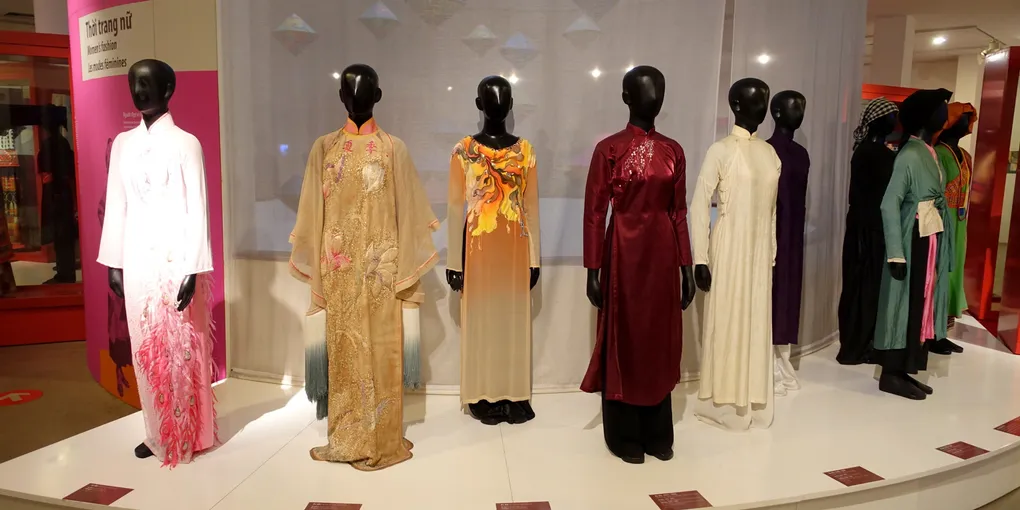
That argument is the most Vietnamese thing about the garment. The áo dài has always been redesigned: by a lord marking a border, by painters arguing about modernity, by tailors solving a sleeve. When you see a row of them in a museum case, as at the Vietnamese Women’s Museum in Hà Nội, you are not looking at a costume frozen in time. You are looking at three centuries of people deciding what Vietnamese should look like.
Sources
- Áo dài — Wikipedia
- Phan Thanh Hải, costume reform under Nguyễn Phúc Khoát and Minh Mạng, Nghiên cứu và Phát triển (Huế)
- A Brief History of the Áo Dài — Saigoneer
- All about áo dài: Vietnam’s national dress — Vietnam Tourism
- Book exploring modern áo dài published — Việt Nam News
Cover photo: áo dài across the eras at the Vietnamese Women’s Museum, Hà Nội, by Daderot, CC0 (public domain), via Wikimedia Commons.
