Every conversation about Phong Nha eventually arrives at Sơn Đoòng, the largest known cave passage on Earth — big enough to hold a jungle and weather of its own. It is a wonderful story. It is also, for almost everyone, beside the point. The expedition takes four days, costs around US$3,000 per person, and is capped at roughly a thousand visitors a year in groups of no more than ten. If that is your trip, you already know it. This post is about the other Phong Nha: the one you can reach on a train ticket and a few hundred thousand đồng, and which is quite remarkable enough on its own.
A landscape shaped by water
Phong Nha–Kẻ Bàng is a block of limestone on the Vietnam–Laos border that has been dissolving, slowly and thoroughly, for hundreds of millions of years. UNESCO listed it as a World Heritage site in 2003 for its geology, extended the listing in 2015 for its biodiversity, and in July 2025 joined it with Laos’s Hin Nam No National Park to form the first transboundary World Heritage site involving Vietnam. The administrative map has shifted too: since the provincial mergers of 1 July 2025, the park sits in the new, larger Quảng Trị province rather than Quảng Bình, although Đồng Hới remains the gateway and the provincial capital.
The organising idea for a visit is simple. Water made these caves, and water decides when you can see them. Keep that in mind and most of the practical advice follows naturally.
Phong Nha Cave: arriving by river
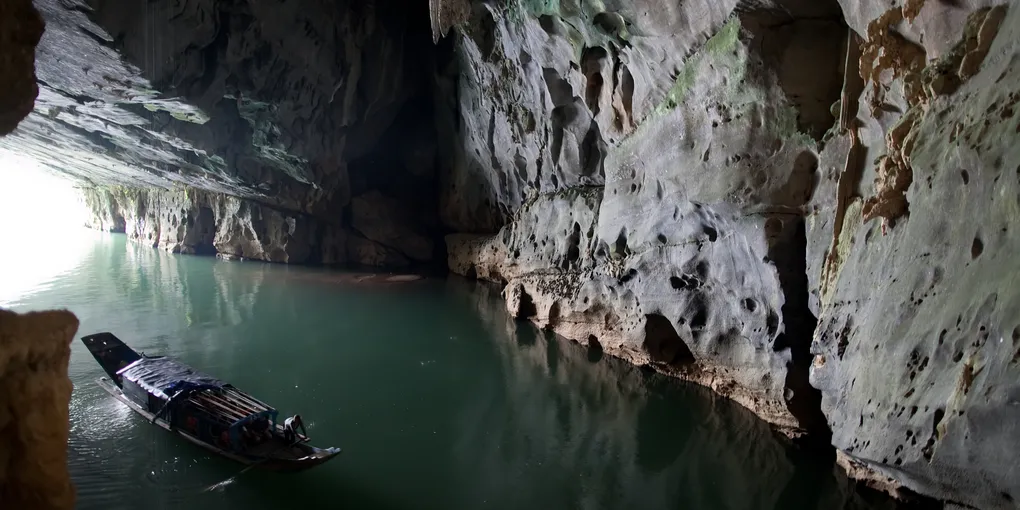
The namesake cave is the gentlest introduction. Boats leave from the jetty in Phong Nha town and motor up the Son River for about half an hour before the engine is cut and the boat slips into the cave mouth on the current. Inside, you glide along an underground river — the cave runs for more than seven kilometres, but visitors see roughly the first one and a half — before stepping ashore to walk back past the formations. Allow one and a half to two hours in total. The boat is priced per vessel rather than per head, so it pays to share one; at the jetty this is easily arranged.
It is busy, and the lighting inside is enthusiastic rather than subtle. Go early, and it is still lovely: the moment of passing from daylight into the cool dark on water is the thing people remember.
Paradise Cave: the one that silences people
About an hour’s drive into the park, Paradise Cave (Động Thiên Đường) is the reason many visitors come. It was only found in 2005, and surveyed passages run for about 31 kilometres, making it one of the longest dry caves in Asia. The public route is a wooden boardwalk through the first kilometre — and that kilometre is enough. The chambers are vast, the stalagmites stand like temple columns, and the scale takes a minute to register. Expect a steep climb of several hundred steps up to the entrance, or pay a little extra for the electric cart that covers part of the approach.
Beyond the headline caves
Dark Cave (Hang Tối) is the playful option: a zipline across the river, a swim into an unlit cave, a wallow in a pool of mud, and kayaks back. It is touristy and unapologetically fun, and not for anyone who minds getting filthy. For something slower, rent a bicycle or motorbike and ride the loop through Bồng Lai valley behind Phong Nha town — rice fields, buffalo, karst walls and farm lunches. It is the part of the trip that feels least like sightseeing, and for many people it becomes the highlight. If you want a real cave adventure without the Sơn Đoòng price tag, licensed operators run one- and multi-day expeditions to caves such as Tú Làn and Hang Én; they need reasonable fitness and advance booking.
Honest downsides
Phong Nha town exists for tourism and looks like it: guesthouses, tour desks and a strip of backpacker bars. The main caves are crowded between mid-morning and mid-afternoon. And the weather is the big one — central Vietnam’s rainy season runs roughly from September to December, bringing heavy rain, typhoons and floods. Boats may stop running when the river rises, Dark Cave sometimes closes, and the adventure caves shut for the season. Visiting now, at the end of September, is possible, but build in slack and check conditions the day before.
Practical notes
- Getting there: fly to Đồng Hới (direct flights from Hà Nội and Hồ Chí Minh City), or take the overnight train — about 9.5–10.5 hours from Hà Nội. Phong Nha is roughly 45 km from Đồng Hới: under an hour by car, longer by local bus.
- How long: two full days covers Phong Nha Cave, Paradise Cave and the valley; add a third for Dark Cave or a guided cave trek.
- When: spring and early summer (roughly March to August) are the reliable months — calm water, open caves, though June–August is very hot. Avoid October–November if seeing the caves is the whole point.
- Costs (at the time of writing): roughly 150,000đ for Phong Nha Cave plus the shared boat fee, 250,000đ for Paradise Cave, and around 450,000đ for the Dark Cave package. Prices change, so treat these as a guide.
- Eat: in Đồng Hới, try Quảng Bình’s cháo canh, a thick rice-flour noodle soup that is the region’s breakfast. In the valley, farm lunches of grilled chicken and fresh vegetables are the move.
- Stay in a homestay along the river or in the valley rather than on the main strip — the whole point is waking up with the mountains.
Cover photo: the river flowing into Phong Nha Cave by [Tycho] (shansov.net), CC BY-SA 3.0, via Wikimedia Commons.
