Vietnamese schoolchildren learn the saying before they learn where the place is: “Thứ nhất Kinh Kỳ, thứ nhì Phố Hiến”, “First the capital, second Phố Hiến.” The capital is Thăng Long, today’s Hà Nội. Phố Hiến is a stretch of riverbank about 50 km downstream, in what is now Hưng Yên. For much of the seventeenth century it was where Đàng Ngoài, the northern realm that Europeans called Tonkin, met the outside world. Today most of it is quiet streets, temples and a river that has wandered away.
A town named after an office
The name tells you what the place was for. “Hiến” most likely comes from the Hiến ty, the provincial inspectorate that the Lê court placed here for the region of Sơn Nam, probably after King Lê Thánh Tông reorganised the country in the late fifteenth century. Sitting on the left bank of the Red River, the office could watch the traffic between the sea and the capital. “Phố” means a street or market town. Phố Hiến was, in short, the market that grew up around a checkpoint.
The checkpoint mattered more once foreign merchants arrived. In the seventeenth century the Trịnh lords, who held real power in the north behind the Lê kings, wanted foreign trade, and foreign guns, for their long war with the Nguyễn lords in the south. They did not want foreigners wandering freely around the capital. Phố Hiến became the place where ships were inspected, passes issued and visitors kept at arm’s length. A study of Western sources in the Journal of Historical Studies sums up the arrangement this way: Phố Hiến was the customs post and temporary lodging for foreign merchants, while Thăng Long was the commercial centre.
Silk, silver and the Dutch
The first Dutch East India Company (VOC) ship reached Tonkin in 1637. The Trịnh received it warmly, mainly because they hoped for a military alliance against the Nguyễn. The Dutch were first housed at Phố Hiến before moving upriver to the capital. How long a real Dutch factory lasted at Phố Hiến is still argued over: historian Đỗ Thị Thùy Lan has argued that the evidence for it is thin and finds no trace of one in the 1670s or 1680s. What is certain is the trade that passed by. Tonkinese raw silk went to Japan in exchange for Japanese silver, which made the Dutch rich for a few decades. The English East India Company kept a factory in Tonkin from 1672 to 1697, and the VOC finally left in 1700.
Chinese merchants were the most lasting foreign community. Some had settled in the area long before the Europeans came, and their temples are still there: the Thiên Hậu temple to the sea goddess Mazu, and the Đông Đô Quảng Hội assembly hall.
What one Englishman saw in 1688
The best eyewitness is the English sailor William Dampier, who sailed up the Red River in 1688 and wrote it up in his Voyages and Descriptions (1699). He calls the town “Hean”, and his description is plainer than the folk saying:
“’Tis a considerable Town, of about 2000 Houses … the Inhabitants are most poor People and Soldiers, who keep a Garrison there … it has neither Walls, Fort, nor great Guns.”
He notes that the governor of the province lived there and that the governor or his deputy issued a pass to “all Vessels that go up or down”. There was “one street belonging to the Chinese Merchants”, and the French had a trading post, because they were not allowed to settle at the capital. The French bishop’s palace, Dampier says, was “the fairest building in Hean”. The English, by then, were based in the capital itself, which Dampier calls Cachao.
So the Phố Hiến of the late seventeenth century was a garrison and customs town with a busy foreign quarter. It was not a glittering metropolis. A stele dated 1625 already praises it as a “little Tràng An”, a miniature capital, but historians have asked how far that pride matched reality. The saying is real, but it ranks Phố Hiến against other Vietnamese towns, not against Nagasaki or Batavia.
Why it faded
No single cause explains the decline, and Vietnamese historians give several:
- The river moved. Red River silt built up the banks, and the main channel today runs roughly 2 km from the old waterfront. Some writers link this to dike-building, which kept the silt inside the riverbed.
- The trade moved. After the Qing dynasty lifted its ban on sea trade in 1684, merchants could deal with China directly and no longer needed middlemen such as Tonkin. The English left in 1697 and the Dutch in 1700.
- Power moved. Rebellions and the Trịnh–Tây Sơn wars in the eighteenth century disrupted the north. In 1802 the new Nguyễn dynasty made Huế its capital. Phố Hiến became the seat of the new province of Hưng Yên in 1831, but as an administrative town rather than a port. Later, Hải Phòng took over as the north’s gateway to the sea.
What remains
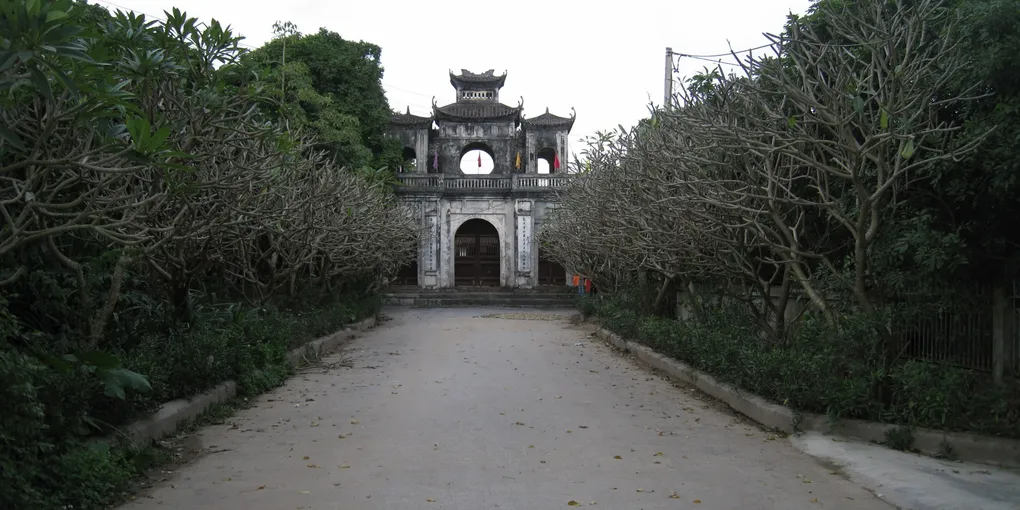
The scholarly revival began with an international conference on Phố Hiến in 1992, organised by the Vietnam Association of Historical Sciences. On 31 December 2014, Decision 2408/QĐ-TTg ranked the Phố Hiến relic complex as a special national monument. The complex covers Vietnamese, Chinese and Confucian sites side by side: Chùa Chuông (the Bell Pagoda), Đền Mẫu, Đền Trần, the Thiên Hậu temple, Đông Đô Quảng Hội, and the Văn Miếu Xích Đằng, the region’s Temple of Literature, whose gate is shown above.
The map has changed again since then. In 2025 Hưng Yên province absorbed Thái Bình, and the old town became Phố Hiến ward of the enlarged province. The province now has plans to restore the old port quarter. Whether that works or not, Phố Hiến still makes a point worth remembering: Vietnam was connected to the early modern world long before the French arrived, through a river checkpoint where Japanese silver, Chinese merchants and Dutch ledgers all passed the same customs post.
Sources
- The North-Eastern seaports and the seventeenth-century commercial system of Tonkin as seen from Western sources — Journal of Historical Studies (VJOL)
- Đỗ Thị Thùy Lan, On the Existence of the VOC Factory in Phố Hiến in the Seventeenth Century — Journal of Historical Studies (VJOL)
- Đỗ Thị Thùy Lan, Phố Hiến research article — Tạp chí Nghiên cứu và Phát triển, Huế (VJOL)
- William Dampier, Voyages and Descriptions, vol. II (Supplement: Tonquin) — TextGrid Repository
- Letter from the King of Tonkin concerning the termination of the trading relation with the VOC, 1700 — ANRI
- Hoang Anh Tuan, Silk for Silver: Dutch–Vietnamese Relations, 1637–1700 — Leiden University
- The ancient Hiến town is alive with history — Việt Nam News
- Phố Hiến thương cảng một thời vàng son — Đại Đoàn Kết
- Tên gọi Phố Hiến xuất hiện từ bao giờ? — Dân Việt
- Bảo tồn và phát huy giá trị di tích lịch sử – văn hóa Phố Hiến — Tạp chí Quản lý Nhà nước
- Thêm 14 di tích được xếp hạng di tích quốc gia đặc biệt — Pháp Luật TP.HCM
- Phố Hiến — Wikipedia tiếng Việt
Cover photo: the gate of Văn Miếu Xích Đằng, Phố Hiến, by Nguyễn Thanh Quang, CC BY-SA 3.0, via Wikimedia Commons.
