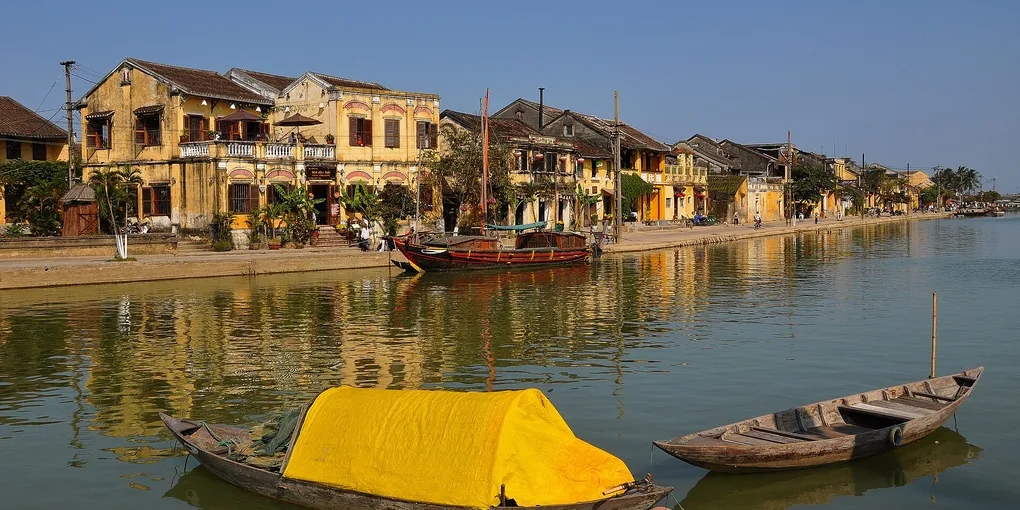
Every photograph of Hội An seems to be taken at the same hour: dusk, silk lanterns glowing over the river, paper candles drifting past wooden boats. It is a lovely sight, and it is also the least interesting thing about the town. The lanterns are the most recent layer of a place whose real story is about something else entirely — a river, and what happened when the river stopped being useful.
The organising idea for a good visit is simple: Hội An is a port town that outlived its port. Once you see it that way, the right way to spend your days becomes obvious.
A harbour without ships
From roughly the 16th to the 18th centuries, Hội An was one of the busiest trading ports in Southeast Asia. Japanese and Chinese merchants settled here, built houses, guild halls and temples, and timed their visits to the monsoon winds. The town’s most famous landmark, the covered bridge known as Chùa Cầu, is traditionally credited to the Japanese community at the turn of the 17th century, with the small temple on it added later.
Then the Thu Bồn river silted up, larger ships moved north to Đà Nẵng, and Hội An was more or less left alone. That neglect is exactly why it survived. The merchant houses were never torn down for something bigger, and in 1999 the old town was inscribed as a UNESCO World Heritage Site — the standard description is “an exceptionally well-preserved example of a South-East Asian trading port”.
Knowing this changes what you look at. The long narrow shophouses, open to the street at the front and to the river at the back, were warehouses as much as homes. The assembly halls — Phúc Kiến, Quảng Đông, Triều Châu — were the chambers of commerce of their day. The town is less a museum of lanterns than a museum of trade.
Time your day against the crowd
The honest downside of Hội An is that everyone else has read the same guidebook. From late afternoon until about ten at night, Trần Phú, Nguyễn Thái Học and the riverfront are wall-to-wall, and the boat touts and lantern sellers are relentless.
The fix is to invert the usual schedule. Walk the old town early — between six and eight in the morning, when shopkeepers are sweeping their steps, the light is soft on the yellow walls and the market by the river is doing real business with real locals. Use the middle of the day for the merchant houses and assembly halls, when the tour groups are at lunch. Then, when the evening crowd arrives, leave.
Where to go when you leave
The best of Hội An is a bicycle ride outside it, and the countryside is flat enough that almost anyone can manage.
- Trà Quế, about 3 km north, is a vegetable village whose herbs supply the town’s kitchens. It has become an organised “farm experience” stop, but the gardens are genuine, and riding there through the paddies is half the point.
- Thanh Hà pottery village, about 3 km west along the river, still turns clay on hand-spun wheels.
- Cẩm Thanh to the east has the water-coconut forest where you can ride a round basket boat. Be warned that this has become one of the most commercial experiences in the area — loud music and spinning-boat performances included. Go early or accept it for what it is.
- An Bàng beach is a short ride north-east if you need the sea.
With an extra day and calm weather, the Cù Lao Chàm islands are about twenty minutes by speedboat from Cửa Đại — but boats are often suspended from around September to February when the sea is rough, so check before you plan around it.
What to eat
Hội An is one of the best small food towns in the country. Cao lầu is the dish you cannot really get anywhere else: chewy, slightly smoky noodles with pork, greens and crackling. The story goes that the noodles must be made with water from the old Bá Lễ well — locals will tell you it matters; sceptics say it is marketing. Try it and decide. Also on the list: mì Quảng, cơm gà (Hội An chicken rice), and the town’s famous bánh mì, which have their own queues.
Practical notes
Getting there. There is no airport in Hội An. Fly to Đà Nẵng; the airport is about 30–37 km away depending on where you stay, roughly 45 minutes to an hour by car or Grab.
Tickets. The old town has an entrance ticket — 120,000đ for international visitors and 80,000đ for Vietnamese citizens at current prices — which covers the townscape plus entry to a set of heritage sites (the covered bridge or Quan Công temple, a museum, and several houses or halls of your choice). Pay it: it funds the preservation that makes the town worth visiting.
The bridge. Chùa Cầu reopened in 2024 after about nineteen months of restoration with Japanese and Vietnamese experts. Many people complained it now looks too new; the paint will weather.
When to go. February to April is the sweet spot — dry and not yet blazing. June to August is hot. October and November are the flood months: the Thu Bồn regularly spills into the lowest streets, and the late-October 2025 flood was one of the worst in decades. If you visit then, stay away from the riverfront and keep plans flexible.
How long. Two full days is right: one for the town, one for the villages and the beach. More, if you want to slow down — which is the whole point.
One administrative note. Since mid-2025, Hội An is no longer a city of Quảng Nam province but a set of wards within Đà Nẵng city. Signs and maps are still catching up.
Cover photo: the waterfront of Hội An on the Thu Bồn river by Dennis G. Jarvis, CC BY-SA 2.0, via Wikimedia Commons.
