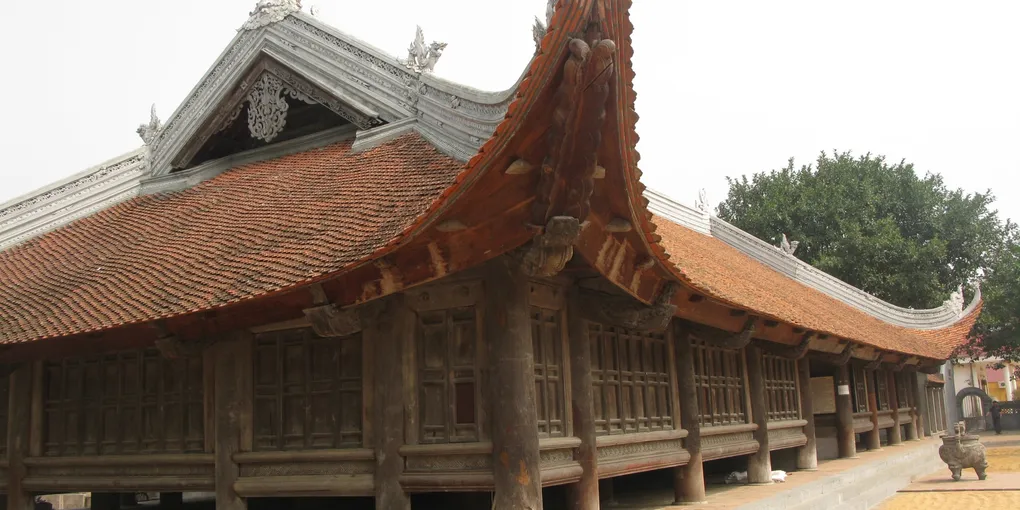
Look closely at the photo at the top of this post. It shows Đình Bảng, one of the most celebrated communal houses in northern Vietnam: a heavy tiled roof, eaves curling up at the corners like the toes of a slipper, a forest of wooden columns standing on stone bases. And in the courtyard, spread out on the brick to dry, someone’s harvest of rice.
That pile of grain says more about the đình than any guidebook. The building is a sacred place, home to the village’s guardian spirit. It is also, and always was, a place for the village’s ordinary business. Few Vietnamese institutions mix the holy and the practical so comfortably.
A temple that is also a town hall
A pagoda (chùa) belongs to the Buddha. A temple (đền) usually honours a particular hero or deity. The đình belongs to the village. Its sanctuary holds the thành hoàng, the tutelary spirit who protects that one community. Its main hall was where the men of the village met to settle disputes, set taxes and decide on festivals. A large drum hung inside, and its beat called people in to discuss village business.
Who the thành hoàng is varies enormously. Sometimes it is a great figure of national legend. Đình Tây Đằng in Ba Vì, west of Hà Nội, honours Sơn Tinh, the mountain spirit of Tản Viên, together with Thánh Gióng and the god of agriculture. Sometimes it is entirely local: the đình of Trà Cổ, on the coast of Quảng Ninh, honours the six fishermen said to have founded the village. Over the centuries the royal court issued sắc phong, decrees of investiture, which recognised these spirits and gave them ranks. A village with a highly ranked spirit could be proud of it, and the decrees were kept with great care.
Phép vua thua lệ làng
Every Vietnamese knows the proverb phép vua thua lệ làng, “the king’s law gives way to village custom.” It is half a joke and half a description of how the countryside was governed. The court in Thăng Long or Huế rarely dealt with villagers one by one. It dealt with the village, through its council of notables, and the village ran its internal affairs according to its own written charter, the hương ước. Historians argue about how far that autonomy really went. Under the Nguyễn, for example, the state backed village charters but also kept them within limits. Still, the proverb captures something real, and the đình was where that custom lived.
Hierarchy was visible in the seating. At feasts and meetings, men sat on mats according to their ngôi thứ, their rank in the village order, decided by age, office, degrees and contributions. Which mat you sat on, and which part of the ritual meat you were served, could start feuds that lasted for generations. Ngô Tất Tố’s 1940 reportage Việc làng (Village Affairs) is full of exactly these quarrels.
The oldest đình, and their surprising carvings
The đình we can still visit are mostly not very old by temple standards, because they are timber buildings in a hot, wet climate, repaired and rebuilt many times. The oldest surviving examples date from the sixteenth century, under the Mạc dynasty. They include Thụy Phiêu, whose pillar carries an inscription dated 1531 (some scholars read it as the date of a repair rather than of construction), along with Tây Đằng and Thanh Lũng. Older stone inscriptions suggest that village đình existed before then, but the buildings themselves have not survived.
What surprises first-time visitors is the woodcarving. These are not stiff images of gods. On the beams of Tây Đằng, sixteenth-century carvers showed people going to market, cutting firewood, ploughing with an elephant, hunting tigers, rowing boats, and young men and women of the village courting. In those panels the village is carving itself, not just its spirit.
The layout grew over time. Early đình were simple halls of three bays with two side wings. From the late seventeenth century a rear sanctuary, the hậu cung, was often added behind the main hall, giving the plan the shape of the character 丁 (đinh). Đình Bảng in Bắc Ninh, built between 1700 and 1736 on the initiative of a local mandarin, Nguyễn Thạc Lượng, is a classic example of that mature form.
There is an old saying, cầu Nam, chùa Bắc, đình Đoài: the best bridges are in Sơn Nam, the best pagodas in Kinh Bắc, and the best communal houses in Xứ Đoài, the region west of Hà Nội. The heritage list seems to agree. Of the ten communal houses given the status of special national monument by late 2023, eight were in the old Xứ Đoài area.
The đình in the South
Travel south and the institution changes shape. In the Mekong Delta and around Sài Gòn the building is usually called đình thần. Most were founded by settlers from the seventeenth to the nineteenth centuries, so they are younger than their northern cousins and often honour pioneers. At Đình Bình Thủy in Cần Thơ and at Châu Phú in An Giang, the festival begins by inviting the spirit of Nguyễn Hữu Cảnh, the lord Nguyễn’s commander who organised the region in 1698.
The great event of the southern đình’s year is lễ Kỳ Yên, the festival of praying for peace. The royal decree of investiture, often kept in the home of a founding family, is carried in procession to the đình. The ritual runs through the night, and hát bội, classical southern opera, is performed for the spirit, with the villagers watching alongside. Remarkably, the Nguyễn court kept issuing decrees to southern spirits even after France had taken all six provinces of Cochinchina in 1867, a way of keeping a cultural hold where it had lost political control.
Going to see one
Đình Bảng is about 20 km from central Hà Nội, an easy half-day trip, and is good for seeing the architecture. Tây Đằng rewards the longer ride to Ba Vì if you want the carvings. In the South, a Kỳ Yên festival at any neighbourhood đình thần is an evening well spent; ask locally, as dates follow each village’s own calendar.
But the best way to understand a đình is the least planned: wander into any village in the Red River Delta, find the big tiled roof by the pond, and see what the courtyard is being used for that day. It might be a festival. It might be a meeting. It might be rice.
Sources
- Vietnamese communal house — Wikipedia and Đình — Wikipedia tiếng Việt
- Thành hoàng and the đình: Vietnam’s village guardian spirits — Vietnam Tourism
- Housing a communal tradition for centuries — Viet Nam News
- Đình Tây Đằng — bảo tàng nghệ thuật thế kỷ XVI — Đại Biểu Nhân Dân
- Đình Bảng communal house — Wikipedia
- “Luật làng” thời nhà Nguyễn — Báo Pháp Luật
- Rước lễ Kỳ Yên — Sài Gòn Giải Phóng
Cover photo: Đình Bảng communal house, Bắc Ninh, by Bình Giang, public domain, via Wikimedia Commons.
