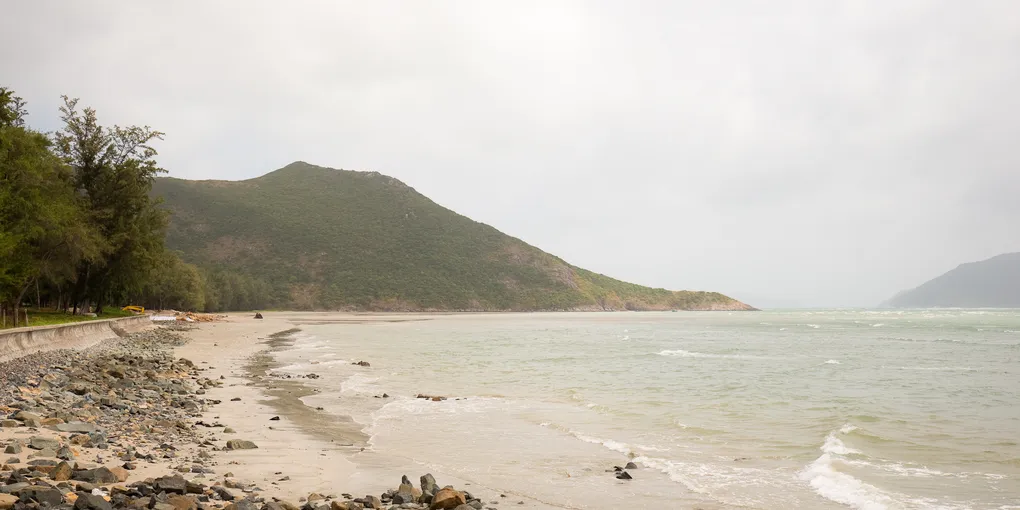
Most beach destinations want you to forget things. Côn Đảo, a sixteen-island archipelago in the South China Sea off the Mekong delta, asks you to remember. The same island that sells itself today on empty coves, coral and sea turtles spent more than a century as Việt Nam’s most notorious prison, and the two identities are not in separate parts of town. The prison buildings sit a few streets back from the seafront promenade in Côn Sơn, the only real town. The cemetery is a short walk from the hotels.
That is the organising idea of any good trip here: you are visiting a beach and a memorial at once, and the island is at its best when you give both their due.
The prison island
The French seized the archipelago in the early 1860s and almost immediately turned it into a penal colony. For more than a hundred years, under the French and then the Saigon government, it held political prisoners: nationalists, communists, anyone the authorities wanted far from the mainland. Many of the men who later ran the country passed through these cells, and tens of thousands of prisoners died here. Exact figures vary widely between sources, so treat any single number with caution.
The prison complex is now a museum site, and the buildings are deliberately left bare. The most infamous are the tiger cages (chuồng cọp): rows of stone pits roofed with iron bars, so that guards walking on the catwalk above could look down on the prisoners, and torment them. Their existence was officially denied until July 1970, when a visiting US congressional delegation broke away from its planned tour. A former inmate had given them a map, and they found the cages behind a vegetable garden. The photographs, taken by congressional aide Tom Harkin and published in Life, caused an international outcry. Standing on that catwalk today is the single most sobering experience the island offers. It should be.
Then there is Hàng Dương cemetery, named for the casuarina trees that line it. Most visitors go to the grave of Võ Thị Sáu, a teenage resistance fighter executed here in 1952. Visiting her grave around midnight has become a pilgrimage ritual for Vietnamese visitors, who bring flowers, incense and offerings. Foreign travellers are welcome, but this is worship, not a show, so dress and behave accordingly. Many of the graves are unmarked.
The island that kept its forest
The prison had an accidental side effect. Because the archipelago was off-limits for so long, it never went through the logging and beach-strip development that much of the coast did. Côn Đảo National Park, established in 1993, now covers both forest and sea, about 200 km² in total, and it is a Ramsar wetland site. The water around the outer islands is some of the clearest in the country. You can snorkel over coral off Hòn Bảy Cạnh and Hòn Cau, and on the main island you can walk forest trails down to near-empty coves such as Đầm Trầu, where planes come in low over the sand.
The headline wildlife is the green sea turtle. Roughly from April to October, females haul themselves up the beaches of Bảy Cạnh to nest. Park rangers move the eggs to protected hatcheries and release the hatchlings. Small numbers of visitors can join an overnight trip to watch the nesting, and the half-day hatchling-release tours are the more common option. Both are capped and need booking through the park or a licensed operator. Do not expect a guaranteed sighting, and do not use a flash.
The honest downsides
Côn Đảo is not cheap by Vietnamese standards. Flights are short but pricier than mainland routes, and the luxury resorts set the island’s reputation, though guesthouses in town are perfectly decent. The real constraint is the weather. The northeast monsoon, roughly November to February, brings rough seas around the island. Ferries get cancelled, boat trips to the outer islands get scrubbed, and the water loses its clarity. The cover photo, taken in late December, shows what that season looks like. If you are coming for the sea, March to September is the window. Vietnamese public holidays fill every flight and boat, so avoid them if you can.
Practical notes
- Getting there: The easy way is to fly from Hồ Chí Minh City, about 45 minutes, on small aircraft operated by the Vietnam Airlines group and Vietjet. Book early, because seats are limited. Fast ferries run from Trần Đề in the Mekong delta (about 2.5 hours, the cheapest sea route), from Vũng Tàu, and since 2025 directly from Hồ Chí Minh City (around five hours). Ferry schedules are seasonal and often cut back in the monsoon months, so check the operator before you plan around them.
- How long: Three days, two nights is the standard plan: one day for the historical sites, one for an island-hopping boat trip, and one for the beaches and forest trails. Add a night for a turtle trip.
- Getting around: Rent a motorbike in town. The coastal road is quiet and spectacular.
- What to eat: Seafood, simply grilled, at the night market and the small restaurants along the seafront. Locals will also point you to snacks made from the island’s bàng (Indian almond) nuts as a take-home souvenir.
- Admin note: Since the 2025 reorganisation, Côn Đảo has been a special administrative zone (đặc khu) of Hồ Chí Minh City.
- Respect: Visit the prison in the morning, before the heat sets in, and save the beach for the afternoon. The order matters more than you would think.
Cover photo: a beach on Côn Sơn island by Tycho (shansov.net), CC BY-SA 3.0, via Wikimedia Commons.
